
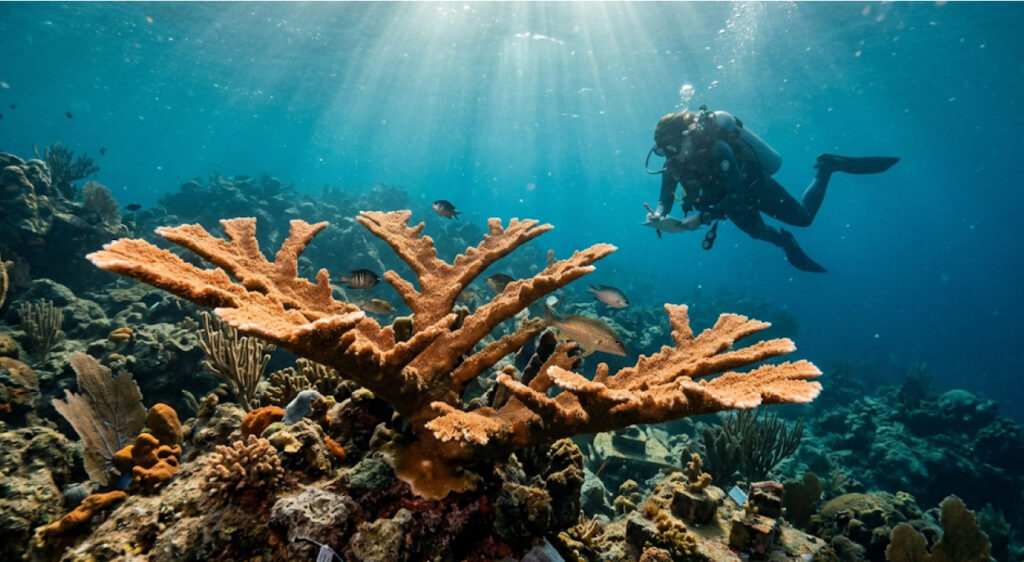
A major coral reef restoration initiative is underway off the eastern coast of Puerto Rico, where the National Oceanic and Atmospheric Administration (NOAA) is investing $5 million to expand the recovery of threatened elkhorn coral. The project, led by marine conservation organization Sea Ventures, targets 30,000 square meters of reef habitat at Cayo Largo, near Fajardo, and aims to establish 30,000 individual corals across 60 restoration plots by 2028.
Announced by NOAA Fisheries on November 2, 2026, the initiative builds on years of restoration work at the site. It combines underwater coral planting, scientific monitoring, genetic preservation, and community training to strengthen a reef ecosystem that supports marine biodiversity and helps protect Puerto Rico’s coastline.
The investment comes as Caribbean coral reefs face mounting pressure from rising ocean temperatures, marine heatwaves, disease, and habitat degradation. For Cayo Largo, however, surviving natural and previously restored elkhorn colonies provide an opportunity to expand recovery efforts and develop techniques that could benefit other reefs across the island.
NOAA and Sea Ventures Expand Restoration at Cayo Largo
The $5 million investment comes through NOAA Fisheries’ Office of Habitat Conservation. Sea Ventures is responsible for implementing the expanded restoration effort at Cayo Largo, a reef located off Puerto Rico’s eastern coast near Fajardo.
The project covers approximately 30,000 square meters, an area NOAA compares to about five and a half American football fields. Its central objective is to increase the abundance of elkhorn coral, scientifically known as Acropora palmata, while supporting a broader and more resilient reef ecosystem.
Sea Ventures and NOAA have worked together at Cayo Largo since 2018. Earlier restoration efforts produced colonies that have grown sufficiently to supply fragments for additional planting. Healthy natural elkhorn thickets also remain in parts of the reef, providing a foundation for further recovery.
The expanded project builds on that experience rather than starting from an untouched site. According to NOAA, Sea Ventures has already completed 22 major coral restoration projects in Puerto Rico. Its work has included responding to vessel groundings, monitoring coral health with NOAA scientists, and treating coral disease.
The first year of the expanded Cayo Largo restoration was completed in September 2026. The next milestone is to establish 30,000 individual elkhorn corals across 60 restoration plots by 2028. These are project targets, not completed planting totals. Continued monitoring will help researchers determine how many colonies survive, grow, and contribute to reef development.
Why Elkhorn Coral Matters to Caribbean Ecosystems
Elkhorn coral is one of the Caribbean’s most significant reef-building species. Its large, branching colonies create complex underwater structures that provide shelter and habitat for fish and other marine organisms. Over time, these formations help build the physical framework of coral reefs.
The species was once dominant across large areas of the Caribbean. Its population, however, has declined dramatically since the 1980s. NOAA identifies disease, ocean warming, ocean acidification, habitat degradation, pollution, and unsustainable fishing as important threats. Elkhorn coral is listed as threatened under the Endangered Species Act.
Disease outbreaks, particularly white band disease, contributed to a severe historical decline. NOAA reports that the population fell by approximately 97% from its former abundance. More recently, marine heatwaves in 2023 and 2024 caused additional damage to elkhorn populations throughout Puerto Rico, the U.S. Virgin Islands, and Florida.
These heat events are especially dangerous because corals depend on microscopic algae living within their tissues. The algae provide much of the energy corals need to survive. When water temperatures remain unusually high, stressed corals can expel these algae, leaving them pale or white. This process is known as bleaching. If stressful conditions continue, coral colonies may die.
Cayo Largo experienced a different outcome from some restoration sites in southwestern Puerto Rico. NOAA reports that natural and previously restored elkhorn corals at the site generally fared better during the 2023 and 2024 marine heatwaves. Scientists have not established a definitive explanation. Genetic differences, local environmental conditions, and other factors may have contributed to the survival patterns.
That uncertainty makes the site scientifically valuable. Researchers can study surviving colonies, assess their characteristics, and use the findings to inform future restoration decisions.
How Divers Are Planting Thousands of Coral Fragments
The restoration process involves coordinated work between divers, boat crews, and scientists. On productive days, a team of six divers, a captain, deckhands, and researchers can place approximately 300 to 500 coral fragments on the reef.
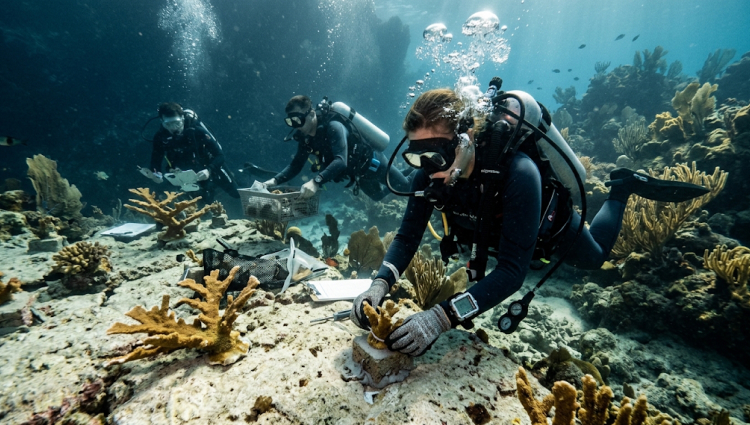
The fragments are secured using a special cement mortar prepared aboard the support vessel. Deckhands mix the material and pass it underwater to divers, who create small cement bases suited to the size of each coral fragment.
The pieces vary considerably in size, ranging from approximately that of a tennis ball to a basketball. Divers position the coral on the prepared base and secure it to the reef. The cement hardens into an inert structure that holds the fragment in place while it grows.
This method helps restoration teams establish colonies in locations where natural recruitment may be limited. It also allows scientists to arrange multiple coral genotypes within restoration plots rather than relying on a small number of genetically similar colonies.
Sea Ventures places at least 10 different elkhorn coral genotypes in each restoration plot. Genetic diversity matters because individual colonies may respond differently to disease, bleaching, storms, and other environmental pressures. A broader genetic mix can improve the chances that some colonies will withstand future disturbances.
The project also incorporates other reef-building species, including massive and boulder corals. This broader approach is intended to support a more diverse habitat rather than depending entirely on a single coral species.
Underwater Photography Helps Scientists Measure Recovery
Planting coral is only one part of the work. Restoration teams must also determine whether the fragments survive, how quickly they grow, and whether the reef develops greater structural complexity.
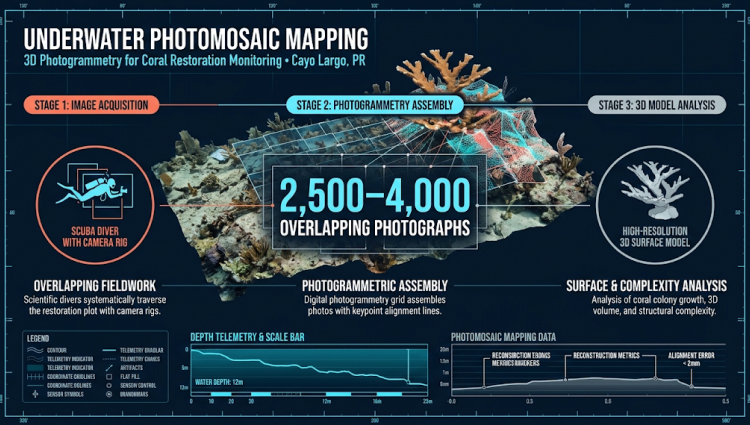
To measure these changes, Sea Ventures uses a technique called photomosaic mapping. Divers swim systematically across each restoration plot while taking thousands of overlapping photographs. NOAA reports that a typical survey can involve approximately 2,500 to 4,000 images.
Scientists later combine those photographs into detailed digital representations of the reef. These high-resolution mosaics allow researchers to examine coral colonies, compare their condition over time, and measure changes in the underwater landscape.
David Repollet, a University of Puerto Rico Ph.D. student and Sea Ventures scientist, is analyzing photomosaic data for his dissertation. He has observed examples of small coral fragments developing branches that eventually cover much of their cement bases within approximately a year and a half.
Those observations are encouraging, but they do not mean every planted coral survives. Repollet has emphasized that some outplants are lost, while future bleaching events remain a significant threat.
The monitoring system is therefore essential to the project’s long-term value. Instead of measuring success only by the number of fragments placed underwater, researchers can evaluate survival, growth, and changes in reef structure. The resulting information can help determine which restoration methods work best under local environmental conditions.
Genetic Preservation Creates Options Beyond the Reef
Another important component of the NOAA investment takes place in laboratories rather than underwater.
Sea Ventures is preserving genetic material from coral populations throughout Puerto Rico through a biobanking approach. The team transfers selected coral fragments to partner laboratories at ISER Caribe, where researchers can maintain live coral in tanks and cryogenically preserve coral tissue.
The objective is to safeguard genetic material that could become unavailable if a particular coral genotype disappears from the wild. Preserved samples may support future restoration, scientific research, and efforts to rebuild populations affected by disease or extreme environmental conditions.
Genetic preservation is particularly relevant for elkhorn coral because the species has experienced substantial population losses. When restoration programs rely on a limited number of surviving colonies, genetic diversity can become an important factor in long-term recovery.
The Cayo Largo project connects this laboratory work with field restoration. Coral fragments can be propagated, grown in ocean-based nurseries, and eventually transferred to restoration sites. Sea Ventures also rescues corals that might otherwise be lost, including fragments broken loose by waves or storms and colonies growing on unstable rubble.
The team is also relocating corals from an abandoned Navy dry dock where healthy brain and massive corals have established themselves on vertical concrete surfaces. Because the structure’s future is uncertain, transferring those colonies offers a way to preserve valuable marine life before its habitat potentially changes.
Local Communities Become Part of the Restoration Workforce
NOAA’s investment also supports education, training, and employment opportunities for people living near Puerto Rico’s coastal ecosystems.
Sea Ventures is providing undergraduate and graduate students with practical experience in coral restoration and marine research. Residents from a nearby fishing community are also training to become coral restoration technicians. Their development includes scuba certification up to the PADI Rescue Diver level.
This approach connects reef conservation with local skills and economic opportunities. Residents who have depended on coastal waters for generations can gain technical experience that supports future restoration projects and marine conservation work.
The educational program also addresses a challenge identified by Sea Ventures coral biologist Manuel Nieves: many people in Puerto Rico, including some who live near the coast, have limited knowledge of the coral reefs located offshore.
To make underwater ecosystems more accessible, the organization has developed an educational program using virtual reality headsets and 360-degree footage recorded at the restoration site. Students and community members can experience the reef without needing scuba equipment or direct access to the underwater environment.
The program introduces coral restoration through an immersive experience while helping explain why healthy reefs matter. It also gives younger participants an opportunity to see the environment that local scientists, divers, and conservation technicians work to protect.
Coral Reefs Provide Natural Protection for Puerto Rico’s Coastline
The value of the Cayo Largo restoration extends beyond the survival of individual coral colonies. Healthy reef systems contribute to coastal protection by absorbing and dissipating wave energy before it reaches shorelines.
NOAA’s National Ocean Service reports that healthy coral reefs can reduce wave energy by as much as 97%. This natural barrier function can help limit coastal erosion and reduce the effects of waves and storms on vulnerable communities.
For Puerto Rico, where coastal areas face recurring hurricane and storm exposure, maintaining reef structure is an important part of broader coastal resilience efforts.
Elkhorn coral is particularly useful because its branching colonies create substantial three-dimensional reef structures. Sea Ventures Project Manager Sean Griffin has explained that the species can withstand strong swells and hurricanes over time, while its durable skeletal structure may remain after individual colonies die.
However, restoration should not be confused with a guarantee of storm protection. Rebuilding a reef takes time, and newly planted corals need to survive and grow before they can contribute meaningfully to the surrounding ecosystem.
The project is therefore one part of a wider conservation strategy. Puerto Rico’s Department of Natural and Environmental Resources published its Coral Reef Restoration Action Plan for 2025–2035, identifying priority locations and restoration objectives across the island. The plan includes Cayo Largo within the Arrecifes de la Cordillera area and identifies the site as a priority for increasing coral abundance and genetic diversity.
The NOAA-funded expansion aligns with those broader objectives by increasing restoration activity at a location where existing coral communities and previous restoration work offer a foundation for further investment.
A Long-Term Test for Coral Restoration in the Caribbean
Sea Ventures plans to continue its expanded restoration work at Cayo Largo through at least 2028. The goal of planting 30,000 elkhorn corals across 60 plots represents a major operational milestone, but the project’s lasting impact will depend on what happens after those colonies are established.
Researchers will need to track coral survival, monitor the effects of future marine heatwaves, and assess whether restored colonies contribute to more complex reef structures. The photomosaic surveys and genetic preservation program will provide information that can guide those decisions.
The work may also create opportunities to use healthy corals grown at Cayo Largo as sources for restoration at other sites around Puerto Rico. Sean Griffin has described a longer-term vision in which the reef develops extensive thickets of elkhorn and other coral species over the next five to ten years.
That outcome is not guaranteed. Ocean warming, disease, storms, and other pressures remain significant obstacles for Caribbean reefs. Nevertheless, the project demonstrates how restoration can combine field science, technology, genetic conservation, and community participation.
NOAA’s $5 million investment gives Sea Ventures the resources to expand an established partnership and test restoration methods at a meaningful scale. More importantly, it places Puerto Rican researchers, students, and coastal residents directly into the work of protecting the marine ecosystems on which their communities and wildlife depend.
For more coverage of marine conservation, habitat restoration, and public environmental initiatives, explore the latest reporting at ITPR.org.