

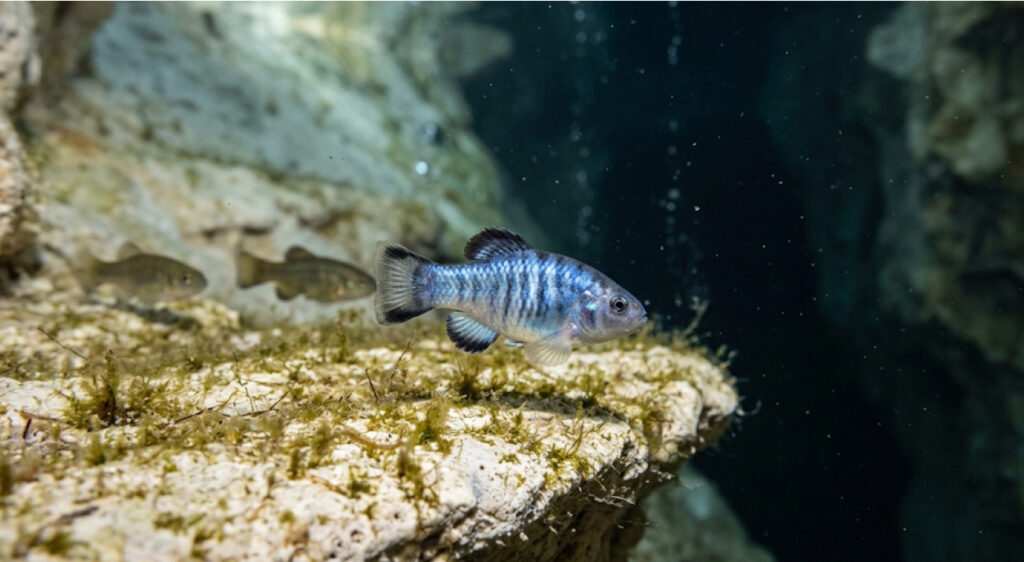
A remarkable increase in one of America’s most endangered fish populations is offering new hope for wildlife conservation in the desert Southwest. Scientists counted 137 Devils Hole pupfish during an October 10, 2026, survey, compared with 77 in spring 2026 and 69 in fall 2025. The National Park Service announced the results on November 3, describing the increase as an encouraging development for a species whose entire naturally occurring population lives in a single water-filled cavern in Nevada.
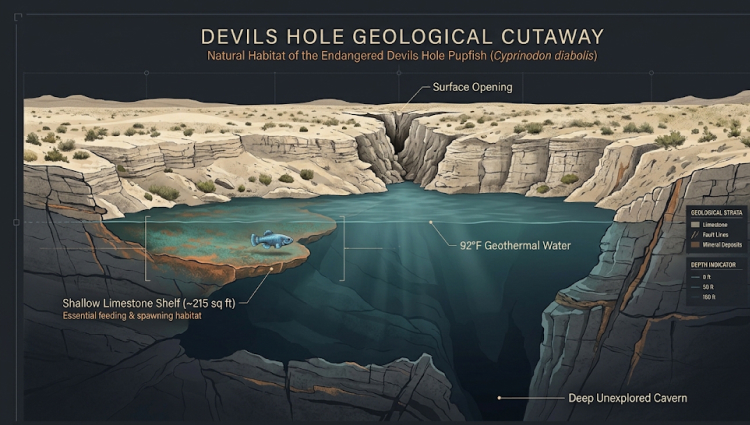
The Devils Hole pupfish (Cyprinodon diabolis) occupies an exceptionally restricted habitat within a detached unit of Death Valley National Park, surrounded by the Ash Meadows National Wildlife Refuge. Its survival depends on a small underwater limestone shelf that provides the food and spawning conditions necessary to sustain the population.
The latest results follow a difficult period marked by earthquake-generated waves, reduced food availability, and a sharp decline in fish numbers during 2025. Conservation teams responded with captive-bred fish releases, supplemental feeding, and continued habitat monitoring. Although the October count suggests that natural reproduction has strengthened, scientists emphasize that the species remains vulnerable to environmental disturbances.
The development highlights how coordinated work by federal wildlife agencies can help protect a species with almost no natural geographic alternatives.
October Survey Records 137 Devils Hole Pupfish
The latest population survey took place on October 10, 2026, with biologists from the National Park Service (NPS) and the U.S. Fish and Wildlife Service (USFWS) working together to count fish inside Devils Hole.
Researchers recorded 137 individuals, an increase of approximately 78% compared with the 77 observed during the spring 2026 survey. The latest result is also nearly twice the 69 fish recorded in fall 2025.
The agencies use a combination of underwater scuba observations and surface counting. Divers examine the deeper sections of the cavern, while observers above the water count fish along visible portions of the habitat. This approach has been used to monitor the population since 1972.
Death Valley National Park Superintendent Mike Reynolds described the increase as an encouraging development, recognizing the work of scientists and conservation partners while emphasizing that significant challenges remain.
The numbers should be interpreted as standardized survey counts rather than an exact census of every fish. The cavern contains deeper areas and small habitat features that can make individual fish difficult to observe. Seasonal conditions, visibility, and the availability of algae also influence the results.
Nevertheless, the progression from 69 to 77 and then 137 provides an important indication that the population has improved since its 2025 decline.
The National Park Service’s November 3 announcement provides the latest official figures and details about the conservation response.
An Extraordinary Fish With Only One Natural Home
Devils Hole is a water-filled limestone cavern located in Nye County, Nevada, within the Ash Meadows region. Although it is geographically separated from the main Death Valley National Park landscape, the site is managed as a detached unit of the park.
The surrounding Ash Meadows National Wildlife Refuge contains a network of desert springs, wetlands, and groundwater-dependent habitats that support numerous endemic species. The Devils Hole pupfish, however, has an especially narrow natural distribution: its only naturally occurring population is found inside this cavern.
The environment is unusual even by desert standards. According to the National Park Service, Devils Hole extends more than 500 feet underground, although its bottom has never been mapped. The water maintains a temperature of approximately 92 degrees Fahrenheit, creating a stable but highly specialized aquatic environment.
The fish are small, generally measuring around one to one-and-a-half inches long. Males often display iridescent blue coloration, while females tend to have olive-green tones.
Their most important habitat feature is a shallow limestone shelf near the water’s surface. The shelf covers approximately 215 square feet and provides the primary feeding and spawning area for the population.
Pupfish feed largely on algae and diatoms growing on the limestone, along with small aquatic invertebrates. Because the shelf is so limited, changes in water movement, sunlight, or food availability can affect a substantial portion of the species’ natural habitat.
The fish have been isolated in this environment for an estimated 10,000 to 20,000 years. Their long separation from other populations has contributed to their distinctive biological characteristics.
This extreme geographic restriction is what makes Devils Hole such an important conservation priority. Unlike species distributed across multiple rivers or wetlands, these fish have no alternative natural habitat where the entire population can relocate if conditions deteriorate.
The NPS Devils Hole overview explains the cavern’s geology, water conditions, and ecological importance.
Earthquakes Disrupted the Habitat and Threatened the Population
The recent improvement follows a serious population decline caused by disturbances in 2024 and 2025.
Earthquakes can affect Devils Hole even when their epicenters are hundreds or thousands of miles away. Seismic energy travels through the Earth’s crust and can produce waves inside the cavern, disturbing the normally stable water surface.
During December 2024 and February 2025, earthquake-generated waves reached approximately six feet in height, according to the U.S. Fish and Wildlife Service. The movement swept algae, organic material, and fish eggs away from the shallow limestone shelf.
That disruption affected both the food supply and the habitat used for reproduction. Because the fish depend so heavily on the same small area, the consequences were substantial.
In April 2025, biologists counted just 38 pupfish during the spring survey. The previous spring’s count had reached 191, illustrating how quickly the population can change when the ecosystem experiences major disturbances.
A separate March 2025 dive had revealed an even more alarming situation, with only about 20 fish observed. These findings prompted conservation agencies to activate measures established under the Devils Hole Pupfish Strategic Plan.
The October 2026 count also followed another seismic event. On October 9, 2026, an earthquake in Panama, nearly 3,000 miles away, generated concerns after biologists initially observed signs of stress among the fish.
A subsequent visit found the animals in healthier condition. The episode demonstrated that the cavern’s water system can respond to seismic activity originating far beyond Nevada.
For researchers, earthquake disturbances remain difficult to predict and prevent. Conservation efforts must therefore focus on maintaining the habitat, monitoring fish health, and keeping additional populations available as a safeguard.
Captive Breeding and Supplemental Feeding Support Recovery
One of the most significant developments in the conservation program has been the use of captive-raised fish to reinforce the natural population.
The Ash Meadows Fish Conservation Facility, operated by the U.S. Fish and Wildlife Service, maintains a protected population that can support recovery efforts when conditions in Devils Hole become dangerous.
The first emergency transfer of captive-raised fish took place in 2025. Nineteen individuals were released during the initial operation, marking the first time captive Devils Hole pupfish had been returned to their natural habitat.
Scientists continued those efforts over the following months. Between March 2025 and February 2026, conservation teams released 72 captive-raised pupfish into Devils Hole.
The releases were conducted carefully to limit handling stress and improve the fish’s chances of adapting to the natural environment. Researchers also monitored their condition and used established protocols to guide the transfers.
The latest population increase provides an encouraging indication that reproduction has continued inside the cavern. The species has an average lifespan of only 10 to 14 months, so biologists believe most of the 137 fish recorded in October were born and developed naturally within Devils Hole rather than being individuals released from captivity.
Supplemental feeding has also supported the recovery process. After earthquake waves removed much of the algae from the limestone shelf, conservation teams provided additional food while natural growth recovered.
Information from the Ash Meadows Fish Conservation Facility and the park’s monitoring program helped guide those decisions.
These measures demonstrate why maintaining a captive population is important even when the natural habitat appears stable. A separate population provides an additional conservation resource if another environmental disturbance causes severe losses in Devils Hole.
The U.S. Fish and Wildlife Service’s account of the conservation partnership describes the emergency response, the work of biologists, and the importance of the Ash Meadows facility.
Long-Term Monitoring Has Protected the Species for Decades
Federal wildlife agencies have monitored Devils Hole pupfish for more than five decades. The standardized population surveys began in 1972, giving researchers a long historical record of changes in the species’ numbers and habitat conditions.
The monitoring program has also revealed that population fluctuations are a natural feature of the species’ life cycle. Counts tend to vary between spring and fall as fish reproduce, mature, and die.
Historically, the National Park Service reported winter counts ranging from approximately 100 to 200 fish, with late-summer populations sometimes reaching 300 to 500. However, the species has experienced substantial declines over the past several decades.
Spring counts exceeded 200 individuals through much of the period before the mid-1990s. By the early 2000s, the average spring count had fallen to approximately 90. A particularly low count of 35 fish was recorded in 2013.
The population later improved, reaching a 25-year high during the spring of 2024, when researchers counted 191 fish. The subsequent earthquake-related decline showed how quickly those gains could be threatened.
The species has received federal endangered status since 1967. Its conservation history also includes important legal and land-management decisions involving groundwater protection.
In the late 1960s, intensive groundwater pumping in Ash Meadows raised concerns that water levels could fall enough to expose the limestone shelf. That would have threatened the fish’s principal feeding and spawning habitat.
A landmark 1976 U.S. Supreme Court decision in Cappaert v. United States upheld federal protection of the water level necessary to preserve the cavern’s habitat. The ruling became an important example of how groundwater rights and environmental protection can intersect.
The establishment of Ash Meadows National Wildlife Refuge in 1984 added another layer of protection to the surrounding spring system.
These historical measures remain relevant today. Protecting the fish requires more than maintaining the water inside Devils Hole; it also depends on preserving the groundwater system and environmental conditions that sustain the cavern.
Why the Latest Increase Does Not Guarantee Long-Term Survival
The October 2026 count is a positive development, but scientists have not declared the species secure.
The pupfish population remains concentrated in one naturally occurring location, making it vulnerable to events that could affect the cavern’s water conditions or shallow feeding shelf.
Earthquakes are one concern, but the broader conservation picture also involves groundwater management, food availability, water chemistry, and the physical condition of the limestone shelf.
The species’ short lifespan adds another challenge. With an average life expectancy of 10 to 14 months, successful reproduction must continue regularly to maintain the population. A disturbance that removes eggs, reduces food availability, or affects breeding conditions can have consequences within a relatively short period.
Researchers therefore need to monitor more than the number of visible fish. Algal growth, water conditions, spawning activity, and the health of individual animals all provide information about whether the habitat can support another generation.
Captive breeding remains an important safeguard, but maintaining fish in a conservation facility is not a substitute for protecting their natural environment. The long-term objective is to maintain a healthy wild population capable of reproducing in Devils Hole without relying on repeated emergency releases.
The October count offers evidence of progress toward that objective, particularly because scientists believe most of the fish observed were naturally produced. Continued surveys will help determine whether the improvement can be sustained.
A Small Population With Major Conservation Significance
The recovery of the Devils Hole pupfish illustrates how conservation work can depend on detailed scientific monitoring, long-term agency partnerships, and carefully planned interventions.

The National Park Service, U.S. Fish and Wildlife Service, and Nevada wildlife specialists have combined population surveys, captive breeding, habitat monitoring, and supplemental feeding to respond to a series of environmental challenges.
The work also highlights the importance of protecting unusual ecosystems that might otherwise receive little public attention. Devils Hole is a relatively small geographic feature, but its ecological significance extends far beyond its physical size.
For ITPR.org readers following national park conservation and environmental protection, the latest count offers a clear example of why long-term research matters. A population increase can signal that recovery measures are working, but continued observation is necessary to understand whether the improvement will last.
With 137 fish recorded in October 2026, Devils Hole has reached a more encouraging position than it occupied during the previous year’s crisis. The next challenge is to protect the fragile limestone shelf, maintain suitable water conditions, and ensure that natural reproduction continues.
For one of the world’s rarest fish, survival still depends on an exceptionally small habitat—and on the sustained work of the scientists and conservation teams protecting it.