

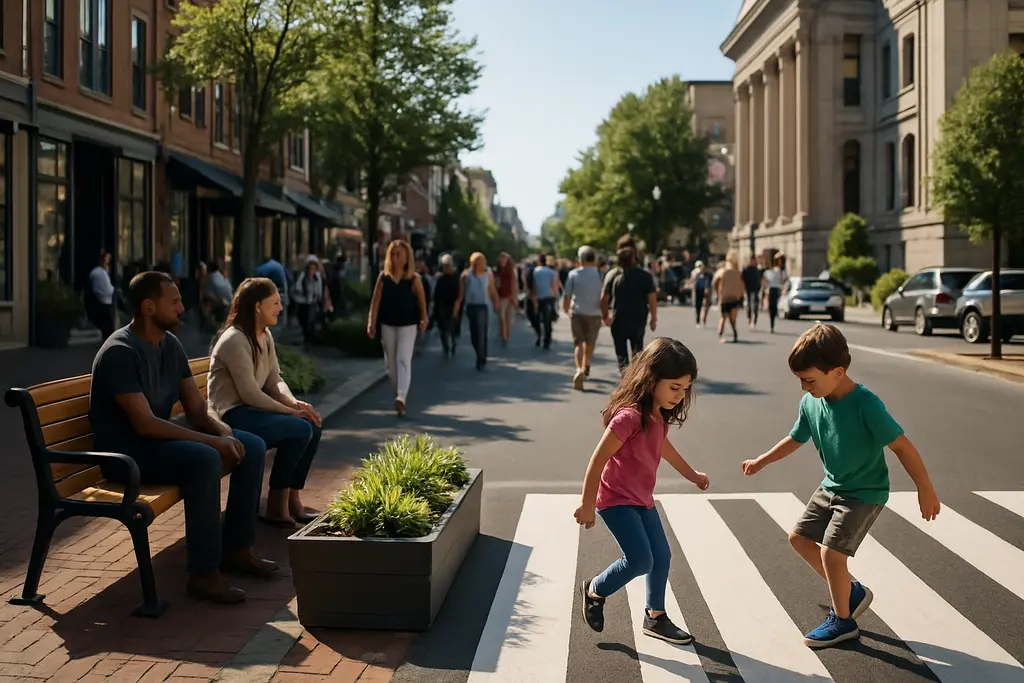
Downtown Streetscape Improvements in Washington, D.C., moved from planning to visible public-space changes in 2026, with the District pointing to the completed Florida Avenue NE Multimodal Streetscape Project and Mamie “Peanut” Johnson Plaza as central examples. According to a DC.gov release, the Florida Avenue work was completed in 2026 as part of a $41 million investment serving Wards 5 and 6, including areas around Gallaudet University, Union Market and NoMa.
What Downtown Streetscape Improvements Changed
The District described the Florida Avenue NE project as a multimodal corridor investment. DC.gov reported that the project realigned streets for two-way traffic, added protected bike lanes, expanded pedestrian access, created three public park spaces and improved safety along a major corridor. Those are physical changes with direct implications for residents, students, workers, cyclists, bus riders, business patrons and people walking through the area.
For community wellness, the most relevant point is not only that a corridor was rebuilt. It is that the District reported changes across several everyday uses at once: walking, biking, traffic movement and public gathering space. A streetscape project that changes only vehicle lanes can affect one set of users. A multimodal project, as described by DC.gov, can touch more parts of daily life because the same corridor serves trips to school, work, retail and transit connections.
Downtown Streetscape Improvements And Public Access
Downtown Streetscape Improvements can be measured partly by whether public access becomes easier to understand and safer to use. DC.gov’s description of Florida Avenue NE included protected bike lanes and expanded pedestrian access, both of which relate to how residents move through the corridor without a car. The release did not provide a project-level count of pedestrian use, bicycle use or crash reduction after completion, so those outcomes should not be overstated based on the cited material.
The reported addition of three public park spaces also matters for neighborhood life. Public space can provide places to pause, meet neighbors or wait between errands and transit trips. DC.gov identified those spaces as part of the Florida Avenue investment, but the cited release did not publish long-term use data for the new plaza or park spaces. That means the current civic takeaway is clear but limited: the physical public-space supply changed, while the longer-term usage pattern still needs official measurement.
Florida Avenue And The FY26 Capital Signals
The Florida Avenue corridor did not stand alone in the District’s reported infrastructure priorities. DC.gov stated that the FY26 budget included $402 million for maintaining roads, sidewalks and alleys in a state of good repair. The same release reported $105 million for expanding the pedestrian and bicycle trail network, $13 million for Capital Bikeshare expansion and $73 million for new bus and bike trail infrastructure.
Those figures matter because they show that the District presented streetscape work as part of a broader capital program, not only a one-corridor upgrade. Residents who experience broken sidewalks, poor alley conditions or gaps in safe bike access may see streetscape projects as isolated construction. The budget categories reported by DC.gov indicate that the city linked corridor work to road maintenance, trails, bus infrastructure and shared bicycle access.
Budget Items Reported By D.C.
DC.gov also reported condition ratings for local streets and alleys. As of 2026, the District said 79% of local streets were rated excellent or good, and 87% of alleys were rated excellent or good. DC.gov compared those ratings with 2015, when it said more than half of local roads and alleys were rated poor or fair.
For residents, those condition ratings are useful because streetscape work is often judged by what people see block by block: pavement quality, sidewalk access, alley conditions and safer crossings. The ratings do not explain the condition of every individual block. They do provide an official citywide indicator that the District says has changed since 2015.
| Reported District Investment Or Measure | Officially Reported Detail |
|---|---|
| Florida Avenue NE project | $41 million investment completed in 2026 |
| Roads, sidewalks and alleys | $402 million in FY26 for state of good repair |
| Pedestrian and bicycle trails | $105 million in FY26 for network expansion |
| Capital Bikeshare | $13 million in FY26 for expansion |
| Bus and bike trail infrastructure | $73 million in FY26 |
| Local streets rated excellent or good | 79% as of 2026 |
| Alleys rated excellent or good | 87% as of 2026 |
Streets For People And Downtown Business Activity
Public-space improvements are not limited to construction. The D.C. Office of Planning reported that the Streets for People Grant Program has supported more than 200 events in Downtown D.C. since its 2022 launch, drawing more than 160,000 attendees. The Office of Planning also reported that nearly two-thirds of surveyed attendees made purchases from nearby downtown businesses.
That program gives a different view of community impact. Road and sidewalk investments change the built environment. Events supported through public-space grants test how people use streets, plazas and downtown gathering areas after design or programming changes. The reported purchase activity is also relevant to small businesses near event locations, though the Office of Planning’s figure is based on surveyed attendees rather than a full accounting of all sales.
Event Grants And Reported Purchases
The Office of Planning stated that nearly $2 million in 2025 grants went to Business Improvement Districts to carry out downtown public-space work. The official figures show a connection between civic programming, downtown foot traffic and nearby commerce, but they do not prove that every event produced the same effect for every business. The careful reading is that the grant program reported significant event activity and survey-based purchasing, while business-level results would depend on location, timing and the type of event.
For residents, the practical impact is that public agencies are using more than construction contracts to shape downtown streets. Programming grants can bring temporary street activity, help test public-space concepts and support local business districts. For workers and visitors, those events may affect how downtown feels during lunch periods, evenings or weekends. For nearby residents, they may raise questions about noise, access, transit coordination and maintenance after events end.
Community Wellness Questions For Residents
From a wellness perspective, Downtown Streetscape Improvements should be evaluated through access, safety, comfort and public use. DC.gov’s Florida Avenue description addressed access and safety through protected bike lanes, expanded pedestrian access and street realignment. The Office of Planning’s Streets for People figures addressed public use through attendance and reported purchases. Together, those official materials show how the District is combining infrastructure and programming in downtown and near-downtown corridors.
The evidence available from the cited sources is useful, but not complete. DC.gov reported investments, condition ratings and project features. The Office of Planning reported event counts, attendance and survey-based purchasing. Neither cited source, within the material used here, provides a full health impact assessment, block-by-block accessibility audit or long-term business outcome study tied to every streetscape change. That gap matters because residents often experience public-space changes differently depending on age, disability status, work schedule, income and transportation options.
Access, Safety, And Everyday Use
For neighborhood stakeholders, the next civic questions are concrete. Are crossings easier to use after street realignment? Do protected bike lanes remain clear and connected? Are sidewalks and park spaces maintained after construction? Do events supported through grants serve a range of residents, or mainly people already spending time downtown? These questions can be raised through District agency meetings, budget hearings and Business Improvement District feedback channels when those opportunities are posted by the relevant public bodies.
- Residents can compare reported citywide street and alley condition ratings with conditions on their own blocks.
- Business owners can track whether nearby public-space events correspond with customer activity during event periods.
- Pedestrians and cyclists can document access concerns through official District service channels when facilities are blocked or damaged.
- Community groups can ask agencies to publish before-and-after measures for safety, maintenance and public-space use.
For related civic coverage across the same publishing network, readers can explore One United Michigan for more insights.
Downtown Streetscape Improvements in Washington
Downtown Streetscape Improvements in Washington should be understood as a mix of completed corridor work, budgeted maintenance, bicycle and pedestrian investment, and grant-funded public-space programming. The District reported the Florida Avenue NE project as completed in 2026, with a $41 million scope that changed traffic patterns, bicycle access, pedestrian space and park space near major neighborhood destinations.
The community impact, based on the official sources cited here, is most clearly documented in physical changes and program participation. DC.gov reported the infrastructure investments and condition ratings. The Office of Planning reported event counts, attendance and surveyed purchasing activity. Those are meaningful indicators, but they are not the same as a full measure of long-term health, equity, safety or small-business outcomes.
For residents, the most useful approach is to treat the 2026 work as a baseline for continued public review. The completed Florida Avenue work can now be assessed through maintenance, accessibility, comfort and safety over time. The Streets for People program can be assessed through attendance, business feedback and how well events serve people who live, work and travel downtown. Public-space improvements affect daily routines, so the strongest civic review will come from matching official project claims with documented conditions on the ground.