

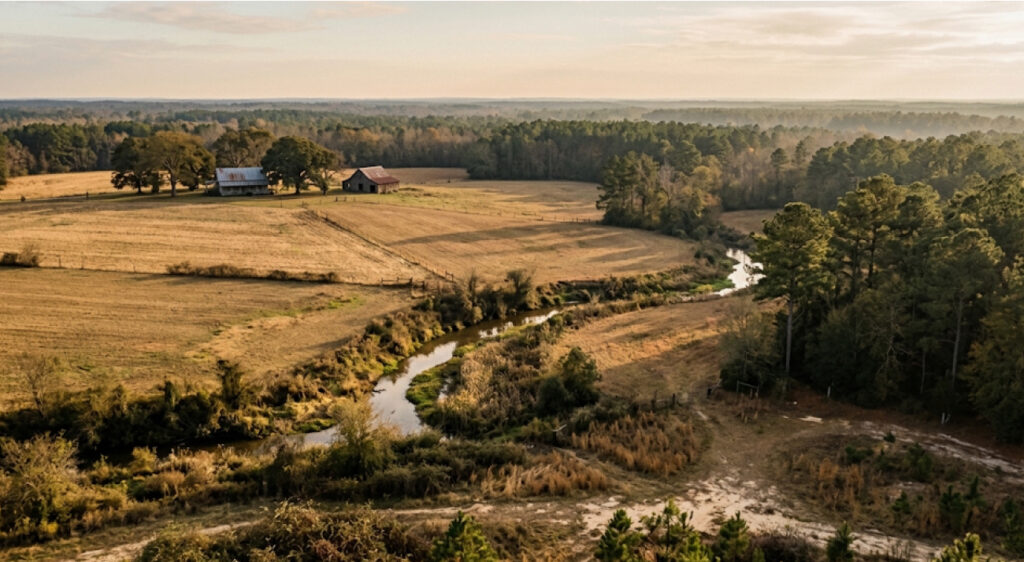
Nearly 2,458 acres of farmland and forest near Plains, Georgia, once cherished by former President Jimmy Carter, are set to receive permanent conservation protection following an $8.5 million acquisition by The Conservation Fund. Announced on November 9, 2026, the transaction preserves a landscape closely connected to the 39th president’s childhood, agricultural roots, family life, and commitment to environmental stewardship.
The nonprofit conservation organization plans to transfer the property to the State of Georgia in 2028. The long-term objective is to incorporate the land into the nearby Lanahassee Creek Wildlife Management Area, expanding the protected landscape to nearly 7,000 acres. Once public access is established, visitors are expected to have opportunities for hunting, fishing, wildlife observation, and other outdoor recreation.
The acquisition also protects important ecological resources in southwest Georgia, including longleaf pine habitat, threatened gopher tortoises, and waterways supporting rare freshwater mussels. For Carter’s family, the agreement offers a way to preserve a place that remained important to him throughout his life while allowing future generations to experience the land.
The project connects a personal chapter of presidential history with a broader conservation effort focused on protecting native ecosystems and expanding public access to natural spaces.
The Conservation Fund Acquires Nearly 2,500 Acres Near Plains
The Conservation Fund announced the acquisition on November 9, 2026, confirming that it had purchased approximately 2,458 acres of the Carter family’s property outside Plains, in Sumter County, Georgia. The reported purchase price was $8.5 million.
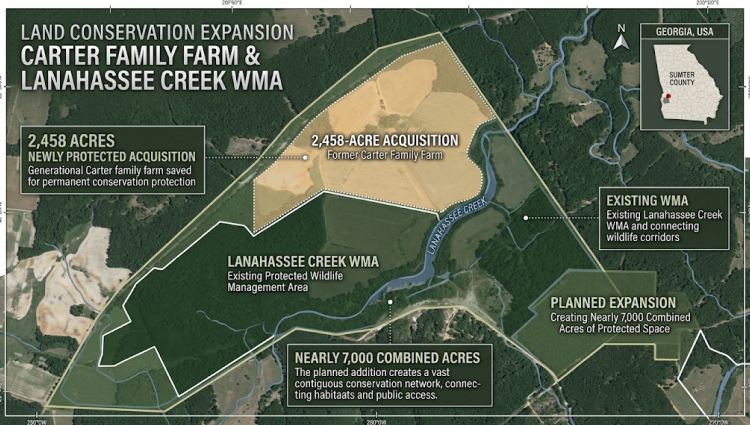
The land includes a combination of agricultural fields, forests, waterways, and natural habitat. Its location next to the existing Lanahassee Creek Wildlife Management Area makes it a strategic addition to Georgia’s protected public lands.
Stacy Funderburke, vice president of the central Southeast region at The Conservation Fund, described the acquisition as an opportunity to protect the landscape that helped shape Carter’s conservation values.
Funderburke emphasized that the property will remain healthy habitat for wildlife while eventually becoming accessible to people who want to experience the area.
Jason Carter, the former president’s grandson, also welcomed the agreement on behalf of the family. He described the property as more than farmland, explaining that it represented home and a place his grandparents deeply treasured.
The purchase represents a partnership between a private nonprofit conservation organization, the Carter family, and the State of Georgia. Rather than allowing the property to become subject to uncertain future development, the arrangement establishes a path toward long-term public conservation management.
According to reporting by The Washington Post, Carter’s daughter Amy and his three sons supported the transaction and its public-access objectives.
The acquisition is especially significant because the property is not simply another tract of rural Georgia land. It is a landscape that connects the history of one American political family with the ecological resources of the state’s upper coastal plain.
A Family Landscape That Shaped Jimmy Carter’s Life
Jimmy Carter’s connection to the property began long before his political career. Growing up in southwest Georgia, he spent time working in the fields and exploring the woods alongside his father, James Earl Carter Sr.
The family operated an agricultural business in the Plains area, working with crops that included peanuts, cotton, corn, and sugarcane. The surrounding land provided both an economic foundation and a familiar rural environment that remained important to Carter after he entered public life.
Following his father’s death in 1953, Carter left his U.S. Navy career and returned to Georgia to manage the family business and agricultural operations. He eventually expanded the peanut enterprise, establishing a stronger commercial operation connected to the region’s agricultural economy.
His relationship with the property continued after his political career took him to the Georgia governor’s office and then the White House. When he returned home, the surrounding woods and fields offered a place away from public responsibilities.
Carter frequently walked the property with his wife, Rosalynn, hunted turkeys, fished in its pond, and observed birds and other wildlife. The land remained a source of personal connection and recreation during his later years.
The family’s conservation decisions also reflected an interest in restoring the property’s native landscape. Carter requested that a stand of mature longleaf pine remain protected. In one of his later land-management decisions, much of the property was replanted with young longleaf pine, helping restore a forest ecosystem that once covered large portions of the southeastern United States.
These decisions are important to understanding why the acquisition carries significance beyond its financial value. The conservation agreement continues a land-management approach that Carter supported during his lifetime: maintaining productive rural landscapes while protecting wildlife and natural resources.
Nearly 7,000 Acres Could Become Part of Georgia’s Protected Wildlife Network
One of the most significant outcomes of the acquisition is the planned expansion of Lanahassee Creek Wildlife Management Area.
The existing management area is listed by the Georgia Department of Natural Resources at approximately 4,420 acres. Adding the Carter property, which covers approximately 2,458 acres, would bring the combined landscape to about 6,878 acres, or nearly 7,000 acres.
This expansion would create a larger connected area for habitat protection and outdoor recreation in west-central Georgia.
The Georgia Department of Natural Resources identifies Lanahassee Creek Wildlife Management Area as a public conservation property in the upper coastal plain region near Preston. Its existing recreational activities include hiking, hunting, primitive camping, and wildlife viewing.
Expanding the management area could improve the continuity of habitat across the landscape. Larger protected areas can give wildlife more room to move, feed, reproduce, and respond to seasonal environmental conditions.
The acquisition also offers an opportunity to coordinate land management across a broader area rather than treating individual properties as isolated conservation sites.
The long-term plan calls for The Conservation Fund to transfer the acquired land to the Georgia Department of Natural Resources in 2028. Public access is expected to begin as early as 2027, ahead of the formal transfer, although specific opening arrangements and recreational rules will depend on the implementation process.
For local communities, the expansion could eventually create additional opportunities for outdoor activities while supporting the conservation of a landscape with significant historical and ecological value.
Longleaf Pine Forests and Gopher Tortoises Benefit From the Acquisition
The property contains habitat associated with one of the southeastern United States’ most important native forest ecosystems: the longleaf pine forest.
Historically, longleaf pine ecosystems covered tens of millions of acres across the Southeast. These forests supported a wide range of plants and animals adapted to open woodland conditions, frequent natural fire, and diverse ground vegetation.
Over time, extensive logging, agricultural conversion, and development reduced the distribution of longleaf pine habitat. Remaining forests are important conservation priorities because they support species that depend on these particular ecological conditions.
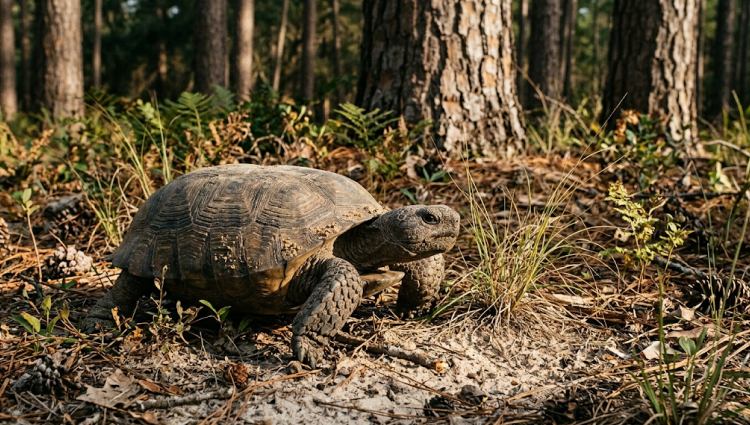
One of the most recognizable species associated with this ecosystem is the gopher tortoise.
The gopher tortoise is a keystone species in southeastern habitats because its underground burrows provide shelter for numerous other animals. Hundreds of species have been documented using tortoise burrows for protection, nesting, or refuge from environmental conditions.
In Georgia, the species is federally listed as threatened. Habitat loss and fragmentation remain major concerns, making the protection of suitable longleaf pine landscapes especially important.
The Carter property provides habitat for gopher tortoises, and its conservation is expected to complement the existing Lanahassee Creek management area’s work to protect the species.
The Conservation Fund has supported broader gopher tortoise conservation initiatives in Georgia, including efforts to protect habitat and reduce the risk of further population declines.
The property’s waterways also contribute to its ecological importance. Creeks near the land support rare freshwater mussels, aquatic species that depend on suitable water quality and functioning stream ecosystems.
Freshwater mussels help maintain healthy aquatic environments by filtering suspended particles and contributing to ecological processes within rivers and streams. Their presence can also provide information about water conditions and habitat quality.
Protecting the surrounding land can help reduce pressures on these waterways by maintaining vegetation, limiting fragmentation, and supporting the ecological processes that sustain aquatic habitats.
Public Access Could Begin as Early as 2027
The planned transfer to the Georgia Department of Natural Resources is intended to turn the acquired property into a public conservation resource.
According to the acquisition announcement reported by WTVM, the land could open to visitors as early as 2027. Once incorporated into Lanahassee Creek Wildlife Management Area, it is expected to support hunting, fishing, wildlife viewing, and other outdoor recreation.
These activities would complement the existing uses of the management area while creating additional opportunities for residents and visitors to experience the region’s natural landscape.
The public-access plan is also important because conservation projects sometimes protect land without providing broad recreational access. In this case, the long-term objective combines permanent habitat protection with opportunities for people to enjoy the property.
However, the planned opening should not be confused with immediate unrestricted access. The Conservation Fund’s ownership period, preparation work, and eventual transfer to the state will determine when different parts of the property become available and which activities are permitted.
The Georgia Department of Natural Resources will ultimately manage the property under applicable wildlife management regulations. Visitors should check official state announcements for opening dates, hunting seasons, access requirements, and any restrictions before planning a trip.
For Plains and nearby communities, the project could also strengthen connections between conservation, outdoor recreation, and local heritage tourism.
The Acquisition Extends Carter’s Environmental Legacy
Jimmy Carter’s conservation record extended well beyond his personal property in Georgia.
During his presidency, he supported major federal land-protection initiatives, most notably the Alaska National Interest Lands Conservation Act, which he signed on December 2, 1980.
The legislation protected more than 104 million acres in Alaska, establishing an extraordinary expansion of national parks, wildlife refuges, and other federally protected lands. It remains one of the most consequential conservation measures in American history.
Carter also supported environmental protections, public-land preservation, and policies addressing energy and natural resource management.
His commitment to conservation was not limited to federal legislation. His family’s approach to land stewardship in Georgia demonstrated an interest in maintaining native forests, protecting wildlife, and preserving the rural landscape around Plains.
The new acquisition brings those personal and public dimensions together. The land where Carter developed his connection to agriculture and the outdoors will become part of a larger protected landscape intended to serve wildlife and future visitors.
The project also reflects the role nonprofit conservation organizations can play in protecting important properties. Organizations such as The Conservation Fund can acquire land, coordinate financing and partnerships, and arrange transfers to public agencies when long-term government management is the intended outcome.
In this case, the nonprofit’s acquisition creates a transition between private family ownership and permanent public conservation management.
A New Chapter for Plains, Georgia, and Its Natural Heritage
The protection of the Carter family farm represents a significant conservation development for southwest Georgia. The 2,458-acre acquisition preserves a landscape connected to a former president’s life while adding important habitat to a growing network of protected public lands.
The planned expansion of Lanahassee Creek Wildlife Management Area to nearly 7,000 acres could benefit longleaf pine ecosystems, threatened gopher tortoises, freshwater mussels, and other wildlife. It also creates the possibility of broader public access for recreation and environmental education.
The project should be understood separately from the existing Jimmy Carter National Historical Park, which preserves important places associated with the former president’s life in Plains, including Plains High School, his presidential campaign headquarters, and the restored Boyhood Farm. The newly acquired family farmland is a separate property and its conservation will not change the boundaries or management of the National Park Service site.
For visitors interested in Carter’s connection to Georgia, the distinction offers two complementary experiences: exploring the historic places preserved by the National Park Service and, eventually, enjoying the broader natural landscape protected through the new state conservation project.
The acquisition also gives the Carter family’s long relationship with the land a lasting public dimension. A property that once served as a place for farming, family life, and personal reflection is now on a path to becoming part of Georgia’s protected outdoor landscape.
As the transfer and public-access plans move forward, the project will provide an opportunity to preserve both the ecological resources of the region and a meaningful part of Jimmy Carter’s personal history.