

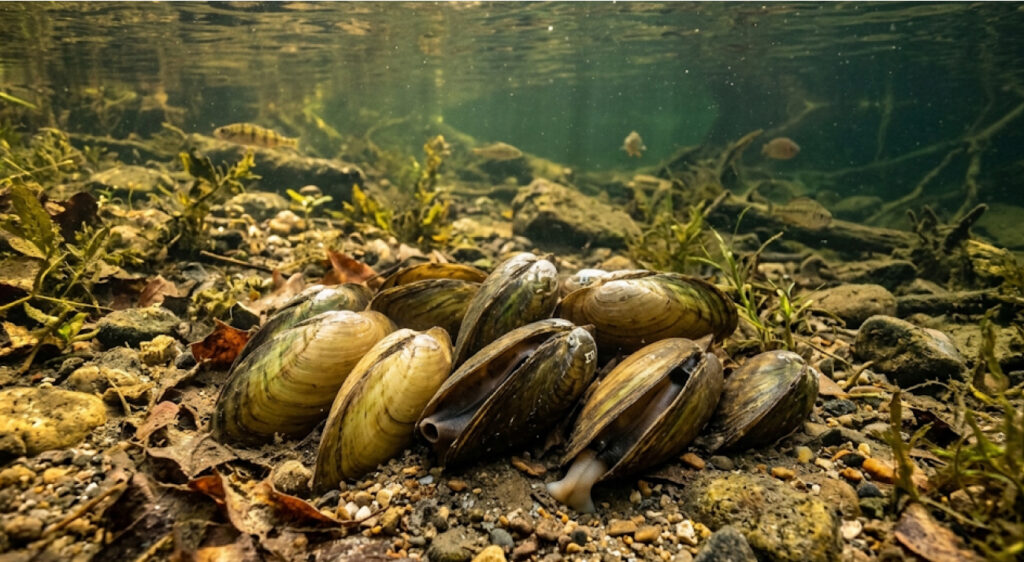
More than 1,600 laboratory-raised freshwater mussels have been released into the East Branch of the Little Calumet River in northwestern Indiana, marking an important milestone in efforts to restore native aquatic wildlife and improve water quality. The National Park Service (NPS), working through Indiana Dunes National Park, raised the mussels from larvae and prepared them for reintroduction after years of research into freshwater mussel propagation.
The release took place in September 2026 and was announced by Indiana Dunes National Park on October 1. The Great Lakes Restoration Initiative highlighted the achievement again on November 9, drawing attention to a restoration program supported by federal funding and nearly a decade of scientific development.
The animals belong to a native freshwater species known as the fatmucket (Lampsilis siliquoidea). Each mussel received an individual identification tag, allowing resource managers to monitor its growth, survival, and movement after returning to the river.
For Indiana Dunes National Park, the project addresses an ecological problem that extends beyond the loss of a single species. Native mussels help maintain aquatic ecosystems by filtering water, stabilizing river sediments, and supporting nutrient cycling. Rebuilding their populations could strengthen the biological health of the Little Calumet River and contribute to broader restoration efforts across the Lake Michigan watershed.
A Major Milestone for Indiana Dunes National Park
The restoration work centers on the East Branch of the Little Calumet River, a waterway flowing through the landscape protected by Indiana Dunes National Park. Located in Porter County, Indiana, the river is part of an interconnected freshwater system that eventually drains toward Lake Michigan.
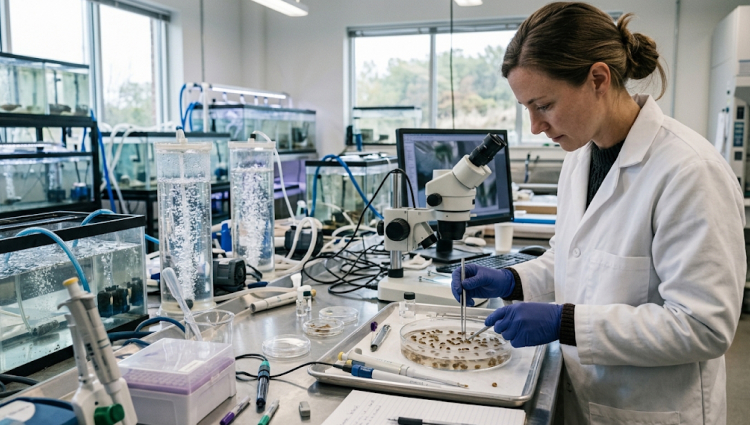
The National Park Service announced that more than 1,600 fatmucket mussels were successfully released after being raised through the park’s Dunes Mussel Propagation Laboratory. The release represented the first group brought from larvae to subadult size through the facility’s propagation program.
Acting Superintendent Leo Lestino described the event as an important step in restoring native mussels that once thrived throughout the watershed. He emphasized their role in river health and the significance of returning them to an ecosystem where native populations have declined.
The project also reflects cooperation between federal conservation programs and park scientists. Funding from the Great Lakes Restoration Initiative has supported the effort to develop reliable methods for producing native mussels that can survive after reintroduction.
The November 9 update from the Great Lakes Restoration Initiative placed the achievement within the wider Great Lakes conservation program. However, the release itself was announced by the National Park Service on October 1, 2026.
The distinction matters because the September release was the result of years of work rather than a newly established project launched in November.
Why Native Freshwater Mussels Disappeared From the River
The Little Calumet River once supported a substantially more diverse freshwater mussel community. Research and historical shell records indicate that approximately 18 native mussel species once inhabited the East Branch drainage.
More recent surveys identified only a small number of surviving species, including limited populations of ellipse and white heelsplitter mussels.
Indiana’s Department of Natural Resources has documented this decline and identified several environmental pressures that may have contributed to the disappearance of native mussels. These include dam construction, wetland loss, dredging, channel modification, pollution, and changes in natural water movement.
The precise contribution of each factor remains uncertain. Historical shells provide evidence of the species that once occupied the river, but they cannot independently establish which environmental pressures caused each population decline.
The loss of freshwater mussels is significant because these animals are sensitive to changes in their habitat. Poor sediment conditions, contaminated water, disrupted river flows, and reductions in suitable fish populations can interfere with their ability to survive and reproduce.
The decline also creates a challenge for natural recovery. Even when water conditions improve, mussels may not return automatically if their populations have become too small or the fish species needed for reproduction are unavailable.
This is why restoration teams have focused on producing young mussels under controlled conditions before returning them to suitable river habitats.
How the Dunes Mussel Propagation Laboratory Raises New Mussels
The more than 1,600 mussels released into the Little Calumet River began their development as larvae inside the Dunes Mussel Propagation Laboratory at Indiana Dunes National Park.
Raising freshwater mussels is a complicated process because their reproductive cycle involves a relationship with fish. Female mussels release microscopic larvae, commonly called glochidia, which must attach to an appropriate host fish to complete an important stage of development in many species.
Once the larvae develop into juvenile mussels, they eventually detach from the host fish and settle into the sediment.
Researchers can support this process by collecting reproductive material, working with suitable host fish, and raising juveniles in controlled environments. Laboratory propagation can also use specialized culture techniques that allow larvae to develop without completing the entire process on a living host fish.
Indiana’s restoration partnership uses both host-fish and laboratory-based propagation approaches. The Indiana Department of Natural Resources provides technical support, including the collection of female mussels used in propagation work.
The young fatmucket mussels released in 2026 were initially raised under controlled laboratory conditions. They subsequently developed under natural river conditions until they reached approximately 20 to 30 millimeters in size.
That measurement was considered suitable for reintroduction.
Reaching this stage represents an important achievement because very young mussels are vulnerable to environmental changes and mortality. Producing animals large enough to be tagged and monitored gives scientists a more practical way to evaluate the results of restoration work.
The program has taken nearly a decade to develop reliable methods for raising native mussels from larvae and preparing them for release. The 2026 event demonstrates that the park’s laboratory can contribute directly to rebuilding populations in a natural river system.
How Mussels Help Improve Water Quality
Freshwater mussels perform an important ecological function as filter feeders. They draw water through their bodies and collect microscopic organic particles, algae, bacteria, and other suspended material.
Through this process, mussels contribute to nutrient cycling and can influence the clarity and biological condition of the water around them.
The National Park Service also identifies their ability to reduce pathogen levels, including bacteria such as E. coli, as one of the potential benefits of restoring native mussel populations.
Their ecological contribution extends beyond filtration. Mussels live partially buried in river sediments, where their presence can help stabilize the substrate. Their feeding and waste processes also move nutrients through the ecosystem, making them part of the food web that supports other aquatic organisms.
These functions are particularly relevant in watersheds where pollution and sediment changes have affected native aquatic communities.
However, releasing 1,600 mussels does not immediately guarantee measurable improvements in river water quality. The environmental benefits depend on how many animals survive, how they grow, whether they reproduce, and whether their populations eventually become large enough to influence ecosystem conditions.
The current release should therefore be viewed as an initial restoration milestone rather than proof that the river’s water quality problems have been resolved.
For scientists, the next stage involves understanding how successfully the introduced mussels establish themselves and whether the river can support additional populations over time.
Individual Identification Tags Will Help Track Recovery
One of the most important features of the 2026 release is that every mussel received an individual identification tag.
These tags allow resource managers to distinguish individual animals during future surveys. Researchers can use the information to evaluate survival, measure growth, and understand how the mussels move within their habitat.
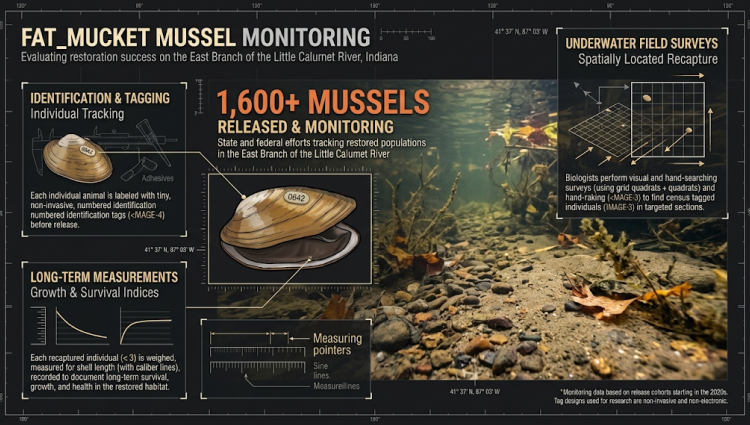
Monitoring will be particularly important during the early years following reintroduction. Some animals may fail to survive, while others may establish themselves successfully in suitable sections of the riverbed.
Scientists will also look for evidence of reproduction. Establishing a self-sustaining population requires more than keeping the original group alive. The mussels must eventually reproduce and produce new generations capable of completing their life cycle.
For fatmucket mussels, that process depends on appropriate environmental conditions and suitable host fish. The presence of healthy fish populations is therefore part of the wider ecological picture.
Future surveys will help determine whether the restored population is progressing toward that objective.
Dr. Charlie Morris, the Indiana Dunes National Park ecologist leading the mussel restoration effort, has emphasized the importance of healthy mussel populations to river ecosystems. His team’s work focuses on rebuilding the biological integrity of the East Branch of the Little Calumet River through practical restoration and long-term research.
The identification tags provide a way to measure whether the program is achieving its intended results rather than relying solely on the number of animals released.
A Wider Partnership Across Indiana’s Freshwater Ecosystems
The Little Calumet River project is part of a broader effort to restore native freshwater mussels throughout Indiana and the Great Lakes region.
The Great Lakes Restoration Initiative provides financial support for environmental projects addressing pollution, habitat degradation, invasive species, and the recovery of native ecosystems.
At Indiana Dunes National Park, the initiative has helped advance the development of mussel propagation methods and the infrastructure needed to support long-term restoration.
The Indiana Department of Natural Resources also plays an important role by providing aquatic biology expertise and supporting propagation activities. The cooperation allows scientists to combine field surveys, laboratory work, and habitat assessments.
Indiana has approximately 60 freshwater mussel species across its aquatic environments, according to the state Department of Natural Resources. Twenty-five are identified as Species of Greatest Conservation Need.
That broader diversity highlights why freshwater mussel conservation matters beyond the East Branch of the Little Calumet River. Different species occupy different habitats, and their survival depends on healthy rivers, lakes, tributaries, and fish communities.
The restoration program also demonstrates the importance of developing local propagation capacity. Instead of depending entirely on external hatcheries, Indiana Dunes National Park can build experience and infrastructure for raising mussels within the region where they will eventually be released.
This approach can support future restoration projects if additional funding, suitable habitat, and successful propagation methods remain available.
Protecting the Little Calumet River Beyond the Release
Reintroducing mussels is only one component of restoring a river ecosystem. Long-term success also depends on maintaining suitable water quality, protecting riverbanks, reducing harmful runoff, and preserving the natural conditions that support aquatic life.
Indiana’s environmental agencies have identified several continuing challenges in the broader Little Calumet watershed. State watershed planning documents discuss concerns involving bacteria, suspended solids, nitrogen, phosphorus, and other pollutants that can affect biological communities.
These pressures demonstrate why mussel restoration must be connected to wider watershed management.
Even a successful laboratory release cannot compensate for persistent pollution or unsuitable habitat. Mussels need appropriate sediment, adequate water conditions, and access to the fish species involved in their reproduction.
The National Park Service is therefore encouraging visitors to leave native mussels and their shells undisturbed. Collecting or moving them can damage fragile animals and interfere with restoration work.
Visitors exploring Indiana Dunes National Park should avoid handling mussels found along waterways or disturbing the riverbed where they live.
The park protects more than 15,000 acres of dunes, forests, wetlands, and rivers along the southern shore of Lake Michigan. Its freshwater habitats form part of a much larger natural landscape that supports wildlife and contributes to regional ecological health.
The Next Test Is Building a Self-Sustaining Mussel Population
The release of more than 1,600 lab-grown fatmucket mussels represents a measurable step in restoring the East Branch of the Little Calumet River. It also demonstrates how scientific propagation can help address population losses that natural recovery alone may not reverse quickly.
The next phase will depend on monitoring the tagged mussels and evaluating their survival, growth, and movement. Researchers will also look for evidence that the animals are reproducing successfully in the river.
Those findings will help determine whether the restoration techniques developed at Indiana Dunes National Park can support larger and more diverse reintroduction efforts.
The broader objective is to rebuild mussel beds capable of functioning as part of a healthy freshwater ecosystem. Achieving that goal will require continued scientific monitoring, suitable habitat, reliable funding, and cooperation among federal and state conservation partners.
The 2026 release does not mark the end of the restoration effort. Instead, it provides researchers with a new population to study and an opportunity to measure whether nearly a decade of laboratory development can translate into lasting ecological recovery.
For more reporting on freshwater conservation, wildlife restoration, national parks, and environmental science, explore the latest coverage at ITPR.org.