

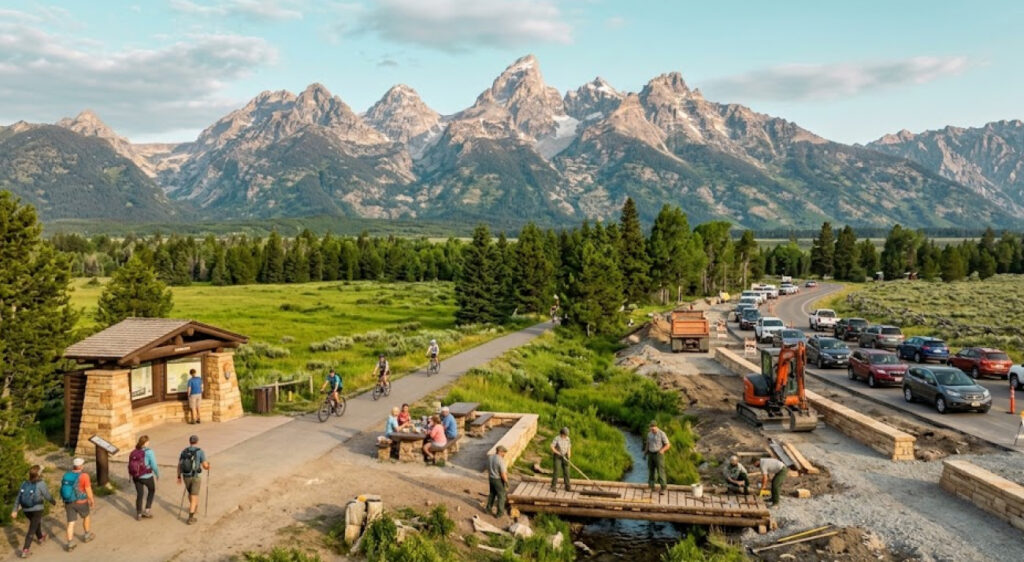
Grand Teton National Park is entering another major phase of infrastructure work as crews continue projects designed to improve trails, visitor facilities, road connections and resource protection across the Wyoming park. On August 20, 2026, the National Park Service announced changing conditions at the Taggart Lake Trailhead, along the Moose-Wilson Road corridor and near Moose, with additional work scheduled to affect the Teton Park Road area. The projects are part of a broader effort to modernize infrastructure while maintaining public access and protecting one of the country’s most heavily visited mountain landscapes.
The changes are particularly important during the busy summer recreation season. Taggart Lake remains accessible, but the northern portion of the trail is closed for reconstruction, forcing hikers to use a longer and steeper southern route. Meanwhile, construction around a future Teton Park Road roundabout will temporarily reduce traffic to one lane, and the Moose-Wilson Road between Moose and the Laurance S. Rockefeller Preserve is scheduled to close to motor vehicles and bicycles after September 7.
Rather than representing a single construction project, the current work illustrates how Grand Teton is approaching infrastructure as a park-wide system. Trails, roads, parking areas, restrooms, pathways, picnic facilities and historic sites all influence how visitors move through the landscape and how effectively the National Park Service can protect sensitive resources.
Taggart Lake Trailhead Enters A Major Reconstruction Phase
The Taggart Lake Trailhead is one of the most visible components of the current construction program. The area is undergoing a multi-year project intended to improve access, address erosion and protect a heavily visited landscape.
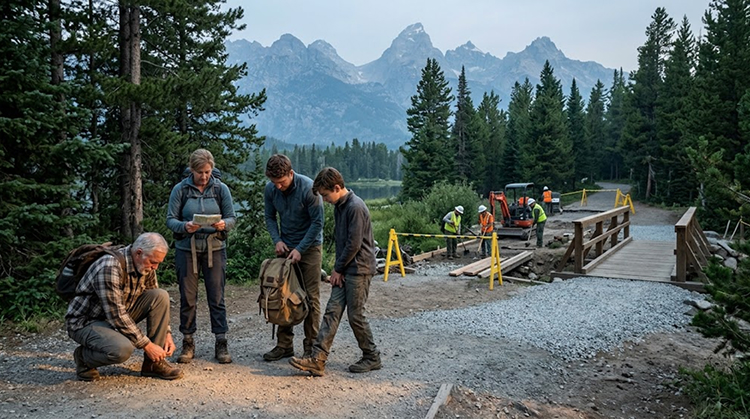
As of the National Park Service’s August 20 update, the trailhead and parking lot remain open, but visitors should expect active construction and changing conditions. The northern portion of the Taggart Lake Trail remains closed for reconstruction. Hikers can still reach Taggart Lake using the southern route, although that alternative is longer and steeper at approximately 4.25 miles round trip.
The eventual redesign goes beyond repairing the existing trail.
The National Park Service plans a renewed trail and trailhead with improved accessibility, educational signage encouraging responsible recreation, restrooms, a water-bottle filling station and a larger parking area intended to accommodate increased visitation.
That combination is significant because visitor demand increasingly puts pressure on popular trailheads. Parking capacity, trail erosion and pedestrian circulation are interconnected problems. Adding parking without improving trail design can simply move congestion farther into the landscape. Likewise, repairing a trail without improving arrival infrastructure can leave visitors concentrated in an already crowded trailhead area.
Grand Teton’s approach addresses those elements together.
The National Park Service describes the work as part of a broader effort to improve roads, trails and visitor facilities as the park approaches its 2029 centennial.
Cottonwood Creek Picnic Area Adds Another Layer Of Work
The nearby Cottonwood Creek Picnic Area is also being upgraded as part of the broader Taggart Lake construction program.
The National Park Service says the picnic area will be updated to better accommodate large vehicles, with additional picnic tables and stream access included in the improvements. The area closed for construction in August 2026.
This may appear separate from the trail project, but the relationship is important.
Picnic areas, trailheads and parking facilities all contribute to how people use the same geographic corridor. When one facility becomes overcrowded or poorly designed, visitors can spill into nearby areas, increasing pressure on vegetation, waterways and informal paths.
Improving a picnic area at the same time as the trailhead allows the park to manage visitor circulation more comprehensively.
The challenge is completing the work without creating a permanent landscape dominated by infrastructure. Grand Teton’s mountain setting is itself a primary attraction, meaning new facilities have to function without overwhelming the scenery visitors came to experience.
That balance between access and preservation is one of the defining challenges of modern national park management.
Teton Park Road Construction Will Affect Traffic Near Moose
A separate project is scheduled to begin during the week of August 24 near Moose, where construction of a bypass for a future Teton Park Road roundabout will temporarily change vehicle circulation.
The National Park Service expects the bypass work to continue for approximately two weeks. During construction, traffic will be reduced to one lane and controlled by flaggers, with potential delays of up to 20 minutes, excluding additional wait times at the Moose Entrance Station.
The construction also affects Menors Ferry Road, which is anticipated to close during the work. Cyclists using pathways are being directed to follow posted signs and may need to use the road shoulder through portions of the construction area, including temporarily unpaved sections. The bypass is expected to be paved at the end of September.
For a park visitor, a 20-minute delay may seem minor compared with the length of a full-day trip. At peak visitation, however, repeated delays can have a cumulative effect on traffic, parking and the timing of hikes and sightseeing stops.
That makes construction communication an important part of the project.
Visitors need to know not just that construction exists but which roads remain open, where delays are expected and which routes have changed.
Moose-Wilson Road Faces A Longer Closure
The Moose-Wilson Road presents a more substantial access change.
The section between Moose and the Laurance S. Rockefeller Preserve is currently open to through traffic, although the National Park Service warns that construction activity can produce intermittent delays of 45 minutes or longer. The road is scheduled to close to motor vehicles and bicycles at the end of the day on September 7, 2026. Construction is expected to continue through November 15.
After November 15, the corridor is expected to transition to seasonal winter recreation use as conditions allow.
The closure also intersects with another important restriction. Death Canyon Road and Death Canyon Trailhead, accessed from the Moose-Wilson Road, remain closed for construction throughout the 2026 season.
These changes illustrate why visitors planning a Grand Teton trip need to treat the park’s transportation system as part of the recreation experience.
A trail that appears close on a map can become considerably harder to reach when a connecting road is closed. A favorite trailhead can remain physically intact while becoming inaccessible from a particular direction.
The National Park Service is encouraging visitors to check current road and trail conditions before traveling into the affected areas.
New Facilities Are Designed Around Long-Term Visitor Use
The Taggart Lake project also demonstrates how visitor infrastructure has changed from simply providing basic access to managing the quality and sustainability of that access.
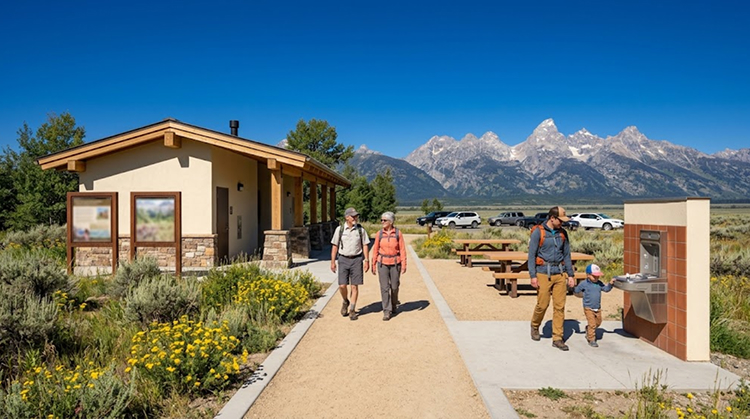
A larger parking area, for example, is not merely an accommodation for more vehicles. It can help reduce informal parking and prevent vehicles from damaging vegetation or compacting soils around the trailhead. Restrooms and water-bottle filling infrastructure can reduce pressure on other facilities while encouraging visitors to prepare for longer outings.
Educational signage has a different purpose. It can influence visitor behavior by explaining why certain areas are protected, where people should travel and how recreation can affect wildlife, vegetation and waterways.
This becomes especially relevant in Grand Teton, where spectacular scenery attracts large numbers of visitors into relatively concentrated areas.
The park’s current construction information identifies Taggart Lake Trailhead and Trail as partially open, while the Cottonwood Creek Picnic Area is closed for construction. The park advises visitors not to enter closed areas or use trails under construction.
The result is an infrastructure strategy that combines physical improvements with visitor management.
Sagebrush Connector Expands The Park’s Pathway Network
Not all of Grand Teton’s current work involves closures or replacement infrastructure.
The Sagebrush Connector represents a longer-term investment in pedestrian and bicycle connectivity. The project extends the Grand Teton Pathway system west of the Gros Ventre Roundabout, creating a new paved path alongside Sagebrush Drive.
The broader Grand Teton Pathway system already connects communities in Teton County with destinations inside the national park, including Jenny Lake and Moose Landing.
The Sagebrush Connector is designed to strengthen that network rather than function as an isolated trail.
| Project | Current Impact | Longer-Term Purpose |
|---|---|---|
| Taggart Lake Trailhead | Partial closure and construction | Improve access, parking, accessibility and visitor facilities |
| Cottonwood Creek Picnic Area | Closed during construction | Upgrade picnic and stream-access facilities |
| Teton Park Road Roundabout Bypass | One-lane traffic and delays | Support future roadway improvements |
| Moose-Wilson Road | Full closure planned after September 7 | Continue major corridor construction |
| Sagebrush Connector | Construction ongoing | Improve pedestrian and bicycle connectivity |
The planned completion window for the Sagebrush Connector extends through September 2026, according to the park’s current construction information.
That project is particularly relevant to the future of recreation access because pathways can reduce dependence on vehicles for shorter trips between communities and park destinations.
Infrastructure Protection Is Also Resource Protection
The justification for the current construction program is not limited to visitor convenience.
The Taggart Lake project specifically addresses erosion and resource protection in a heavily visited area. The redesign of Mormon Row, another active Grand Teton project, similarly seeks to protect wildlife and vegetation while improving visitor access.
At Mormon Row Historic District, construction includes a paved parking lot with designated tour-bus parking, restrooms and shade structures. The park is also developing designated trails and viewing locations around historic buildings to protect natural and cultural resources that are vulnerable to damage from unmanaged visitor movement.
This represents a broader shift in park infrastructure planning.
When visitor numbers increase, leaving facilities unchanged does not necessarily preserve the landscape. Heavy foot traffic can widen informal trails, damage vegetation and accelerate erosion. Vehicles parked outside designated areas can compact soils and affect vegetation. Visitors gathering around sensitive viewpoints can gradually alter the very scenery that attracts them.
Well-designed infrastructure can therefore serve as a conservation tool.
The goal is not simply to accommodate more people. It is to channel recreation into areas and facilities that can withstand use while protecting the surrounding environment.
The Projects Are Part Of A Larger Centennial Strategy
Grand Teton National Park is approaching its 100th anniversary in 2029, and the current construction program is being framed within a broader effort to prepare roads, trails and visitor facilities for the next century.
That timeline gives the current projects additional significance.
The National Park Service is not simply responding to individual maintenance problems. It is attempting to address aging infrastructure, growing visitation, accessibility expectations and resource-protection requirements before the park reaches its centennial.
The approach also acknowledges that infrastructure has a lifespan.
A trail built decades ago may have been appropriate for the number and type of visitors using it at the time. A trailhead designed for a smaller number of cars may become inadequate as visitation patterns change. Facilities that once met basic accessibility expectations may require substantial redesign.
Grand Teton’s current work is therefore an investment in the park’s ability to function under future conditions rather than simply a response to today’s problems.
Visitors Will Need To Adjust As Work Continues
For the remainder of the 2026 construction season, visitors should expect Grand Teton to look different from a normal summer.
The most important changes include the partial closure of the Taggart Lake Trail, closure of Cottonwood Creek Picnic Area, construction delays around Moose, upcoming restrictions on the Moose-Wilson Road and continuing work at other visitor locations.
That does not mean the park is becoming inaccessible.
Instead, access is being redistributed.
Taggart Lake remains reachable from the southern route. Other areas of Grand Teton remain available for recreation, and the park continues to provide information about alternatives and current conditions.
Visitors can also expect construction schedules to change as weather, field conditions and project requirements evolve. The National Park Service specifically notes that project timelines and impacts are subject to change.
For anyone planning a trip, the practical lesson is straightforward: checking conditions immediately before entering the park is increasingly important.
A Larger Investment In How Grand Teton Is Experienced
Grand Teton’s latest construction phase demonstrates that improving outdoor recreation is no longer simply a matter of building another trail or adding another parking space.
The park is simultaneously addressing trail erosion, accessibility, visitor circulation, road safety, bicycle connections, parking capacity, restrooms, water infrastructure and protection of natural and cultural resources.
The projects also show why recreation infrastructure requires long-term planning. A new pathway such as the Sagebrush Connector can influence how people travel through the region. A redesigned trailhead can change where vehicles and pedestrians concentrate. A restored trail can reduce erosion. A new viewing area can give visitors access to scenery while protecting sensitive ground around it.
For a park as visually iconic as Grand Teton, these decisions have consequences beyond construction schedules.
They determine how future visitors will experience Jenny Lake, Taggart Lake, Mormon Row, Moose and the surrounding Teton landscape, while determining how much pressure those places can absorb without losing the characteristics that make them valuable.
The current projects are therefore part of a larger question facing many American public lands: how can recreation access expand while the landscapes supporting that recreation remain protected?
Grand Teton’s answer is taking shape through a combination of redesigned trailheads, stronger pathways, improved roads, better visitor facilities and resource-focused construction. As the park approaches its 2029 centennial, those investments are intended to provide a more accessible and resilient foundation for the next generation of visitors.
For broader coverage of national park recreation, the Grand Teton program provides a useful case study in how infrastructure, conservation and visitor experience increasingly have to be planned as one connected system.