

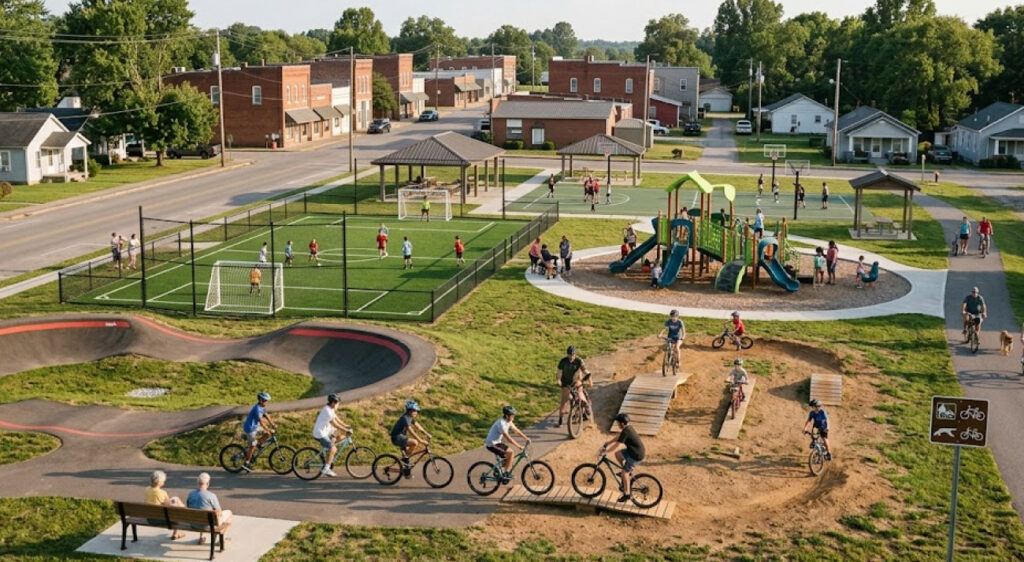
Tennessee is directing more than $20.25 million in new grant funding toward parks, recreation and trail projects across 19 communities, creating one of the state’s latest major investments in local outdoor infrastructure. Announced on August 20, 2026, by the Tennessee Department of Environment and Conservation (TDEC) Office of Outdoor Recreation, the funding includes $18,490,470 through the Local Parks and Recreation Fund (LPRF) and $1.76 million through the Recreational Trails Program (RTP). An additional $6.8 million in matching funds is being provided through the Grant Opportunity Fund for distressed and at-risk rural communities.
The awards reach projects ranging from an indoor community pool in Bolivar and a new park in Stanton to river access, trail connections, sports facilities, playgrounds, a bike skills course and a pump track. The geographic spread is equally important: recipients include communities in West, Middle and East Tennessee, as well as Decatur, Haywood and Unicoi counties.
Rather than concentrating recreation investment in a handful of large destination parks, the latest funding round places substantial resources into smaller community systems where residents can encounter parks, trails and outdoor facilities as part of everyday life. That makes the program relevant to broader questions about recreation access, rural investment and the role of public outdoor spaces in community development.
Tennessee’s Recreation Funding Reaches 19 Communities
The August 20 announcement combines two primary grant programs with a separate rural matching initiative. The LPRF is designed to help local governments acquire land and develop parks, natural areas, greenways and recreation facilities, while also supporting trail development and capital improvements. LPRF awards generally require an equal local match.
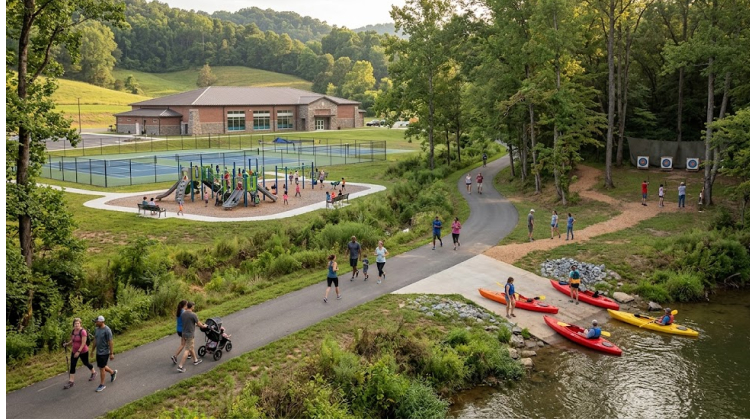
The RTP operates differently. It is federally funded but administered by the state and supports recreational trail acquisition, construction, rehabilitation, maintenance and trailhead facilities. Tennessee distributes the program as an 80% grant with a 20% match based on total project costs.
The resulting portfolio is broad enough to show how outdoor recreation needs differ from one Tennessee community to another.
| Community | Project | Grant Amount |
|---|---|---|
| Bolivar | Bolivar Community Center indoor pool | $3,500,000 |
| Calhoun | Blueway enhancement and trail project | $490,000 |
| Dunlap | Dunlap Pump Track Park | $525,000 |
| Erwin | Erwin River Landing | $392,000 |
| Knoxville | McWherter Park and Suttree Landing Park improvements | $746,730 |
| Mount Carmel | Park sports areas and splash pad | $1,500,000 |
| New Market | Playground and Archery Center | $1,046,225 |
| Newport | Woodland Phase 1 and White Oak redevelopment | $3,500,000 |
| Savannah | Sportsplex improvements | $2,759,568.75 |
| Stanton | New city park development | $562,446.75 |
| Unicoi County | Lower Nolichucky River Takeout | $2,250,000 |
These projects represent different forms of recreation infrastructure rather than a single statewide design model.
The Tennessee outdoor recreation programs provide the administrative framework behind this funding cycle and show how state recreation policy connects local projects with broader conservation and outdoor-access objectives.
Rural Communities Receive Additional Support
One of the most consequential aspects of the funding round is the additional $6.8 million in matching dollars made available through the Grant Opportunity Fund, or GO Fund. TDEC’s Office of Outdoor Recreation partnered with the Tennessee Department of Economic and Community Development (TNECD) to make the recreation grants more accessible to distressed and at-risk rural communities.
Matching requirements can become a significant barrier for smaller governments.
A community may have a clearly defined need for a new trail, playground, river landing or sports facility but lack the financial capacity to provide the required local share. In that situation, a conventional grant can favor communities that already have stronger fiscal resources.
The GO Fund addresses part of that problem by supplying matching dollars to eligible rural communities. That makes the funding structure more than a capital program. It becomes an access mechanism intended to help communities with fewer financial resources compete for recreation investment.
TNECD has made rural development a recurring priority. The department reports that 89% of community grants awarded in 2025 went to rural counties, illustrating the broader emphasis Tennessee has placed on directing public investment beyond the state’s largest population centers.
For recreation planners, that distinction matters because rural park systems frequently serve populations spread across larger geographic areas while operating with smaller tax bases and fewer dedicated recreation resources.
The new funding therefore has the potential to address two problems simultaneously: aging or insufficient recreation infrastructure and the financial limitations that can prevent smaller communities from upgrading it.
Bolivar And Newport Receive The Largest Individual Awards
Two communities stand out in the current funding round because each received $3.5 million.
In Bolivar, the money will support development of a new indoor pool at the Bolivar Community Center. In Newport, the award will support Woodland Phase 1 and White Oak redevelopment. Both projects are classified as LPRF and GO Fund projects, meaning the rural matching mechanism is part of their funding structure.
The Bolivar project is particularly notable because indoor aquatic recreation extends the usefulness of a community recreation system beyond the traditional summer season.
Swimming facilities can support recreation, youth programming, instruction, fitness and community activities in a controlled environment. For a smaller community, an indoor pool can also become a year-round civic asset rather than a seasonal park amenity.
Newport’s award takes a different approach, combining recreation investment with redevelopment. That distinction reinforces a central theme of the current grant cycle: public recreation facilities can serve as pieces of larger community improvement strategies.
The Tennessee rural development initiatives also place infrastructure and community assets within a broader economic-development framework. TNECD describes rural investment as a way to help communities become more competitive, connected and prepared for growth.
Trails Connect Recreation Projects Across The State
Trail funding represents another major component of the announcement.
The $1.76 million RTP allocation supports six communities directly: Calhoun, Dunlap, Knoxville, McMinnville, Milan and Sunbright. Projects include the Calhoun Blueway Enhancement and Trail Project, Dunlap Pump Track Park, the Holston River Park Bike Skills Course, Bigbee River Trail and Linear Parks connectivity improvements, improvements to McKellar Park restrooms and development of a recreational trail at Sunbright City Park.
These projects demonstrate how the term “trail” encompasses considerably more than a conventional hiking path.
In Calhoun, the investment is connected to a blueway, emphasizing water-based recreation and river access. In Dunlap, a pump track creates a specialized cycling environment. Knoxville’s Holston River Park project introduces a bike skills course, while McMinnville’s funding focuses on connectivity between the Bigbee River Trail and linear parks.
That variety is significant because modern recreation networks increasingly rely on multiple types of facilities working together.
A trail can connect neighborhoods to parks. A bike skills course can provide a controlled setting for developing cycling ability. A river landing can expand paddling access. A pump track can create a recreation destination within a relatively small footprint.
The federal Recreational Trails Program provides the broader national framework for this type of investment, supporting recreational trail projects through state-administered funding.
Knoxville Adds Recreation Infrastructure Along The Tennessee River
Knoxville received two separate awards in the current cycle, illustrating how a larger municipality can use different funding streams for different recreation needs.
The city received $746,730 through LPRF for improvements to Tennessee RiverLine McWherter Park and Suttree Landing Park. It also received $400,000 through RTP for a Holston River Park Bike Skills Course.
Together, the projects point toward a recreation strategy that combines riverfront public spaces with active transportation and cycling facilities.
The Tennessee RiverLine is itself part of a broader vision for connecting communities along the Tennessee River through outdoor recreation. Improving existing riverfront parks can increase the value of infrastructure already in place rather than requiring every recreation investment to begin with a completely new park.
This is where grant programs can have an important multiplier effect.
A new facility becomes more useful when residents can reach it through trails, sidewalks, greenways or other connected public spaces. Likewise, a trail becomes more valuable when it leads to parks, waterways, sports facilities or neighborhood destinations.
The Knoxville awards therefore illustrate why recreation planning should be evaluated as a network rather than as a collection of unrelated projects.
Water Access Expands The Definition Of Outdoor Recreation
Several awards also demonstrate Tennessee’s emphasis on water-based recreation.
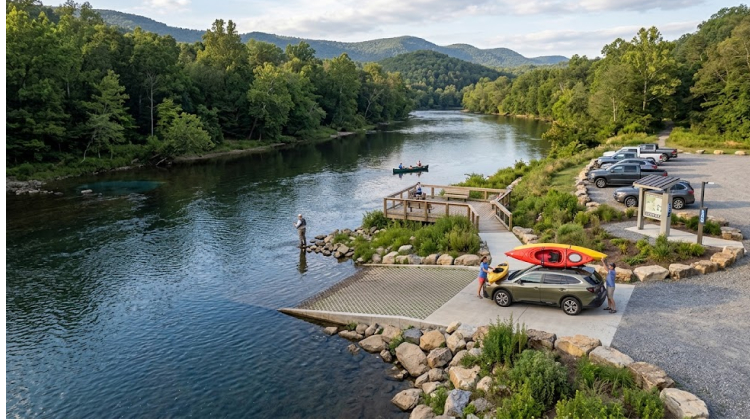
The Lower Nolichucky River Takeout in Unicoi County received $2.25 million, while Calhoun received $490,000 for its blueway and trail project. Erwin’s River Landing received $392,000.
These investments are important in a state where rivers and waterways are major components of the outdoor recreation landscape.
River access can support paddling, fishing, wildlife observation and other activities while providing communities with new ways to use natural assets. But access infrastructure also requires careful planning around erosion, water quality, parking, emergency response and environmental protection.
A takeout or river landing is therefore more than a concrete access point. It is part of a larger management system.
That becomes particularly relevant as outdoor recreation participation increases and communities look for ways to translate natural resources into public amenities without damaging the resources themselves.
Parks Are Also Becoming Community Health Infrastructure
The current grant portfolio includes several projects that directly expand opportunities for physical activity.
Mount Carmel will receive $1.5 million for park sports areas and a splash pad. New Market received $1,046,225 for a playground and Archery Center project. Selmer received $450,000 for renovation or replacement of its city park pool. Savannah received $2,759,568.75 for Sportsplex improvements.
These investments show how recreation policy increasingly overlaps with community wellness.
A park does not have to be labeled as a health facility to influence physical activity. Playgrounds provide structured opportunities for children to move. Sports fields support organized athletics. Trails encourage walking and cycling. Pools can support swimming, instruction and exercise.
The relationship between outdoor space and health is also relevant to ITPR’s broader outdoor recreation and wellness research, particularly when public investment is evaluated through quality-of-life outcomes rather than construction costs alone.
For smaller Tennessee communities, replacing an aging pool or developing a new park can therefore address multiple needs at once: recreation, youth engagement, physical activity and social interaction.
The Funding Portfolio Shows A Different Model Of Park Investment
The most interesting feature of Tennessee’s August 2026 announcement may be the diversity of projects rather than the headline dollar amount.
There is no single definition of what a successful recreation investment looks like. In one community it is an indoor pool. In another it is a river landing. Elsewhere it is a trail connection, playground, bike course, sports complex or new city park.
That diversity reflects differences in geography, population, existing infrastructure and community priorities.
| Project Type | Examples From The 2026 Awards |
|---|---|
| Aquatic recreation | Bolivar indoor pool; Selmer pool; Mount Carmel splash pad |
| Trails | Haywood County Sugar Creek Trail; Sunbright City Park trail; McMinnville Bigbee River connectivity |
| Cycling | Dunlap Pump Track; Knoxville Holston River Bike Skills Course |
| River access | Calhoun Blueway; Erwin River Landing; Lower Nolichucky River Takeout |
| Parks | Stanton new city park; Parsons Memorial Park; Newport redevelopment |
| Sports facilities | Savannah Sportsplex; Mount Carmel sports areas |
| Play and youth recreation | New Market playground and Archery Center |
The approach allows communities to address their most immediate recreation gaps while using state and federal funding to leverage local resources.
What The New Investment Means For Tennessee Communities
The August 20 awards are not simply a list of construction projects. They represent a broader investment strategy in which parks, trails and outdoor facilities become part of community infrastructure.
For rural communities, the GO Fund component is especially important because it can reduce one of the practical barriers to competing for capital funding. For larger cities such as Knoxville, the awards show how state and federal programs can supplement an established recreation network.
The projects will still require design, permitting, construction, maintenance and long-term management. Funding an improvement is only one stage in the life of a public recreation asset.
The eventual impact will depend on whether communities can maintain these facilities, connect them with existing systems and make them usable by residents across age groups and abilities.
Tennessee’s latest funding round provides the capital to move those plans forward. It also creates a statewide test of how effectively recreation investments can translate into everyday access to parks, trails, waterways and active spaces.
With $18.49 million in LPRF awards, $1.76 million in trail grants and $6.8 million in additional rural matching support, Tennessee is placing substantial resources behind that objective.
The projects now move from funding announcements into implementation, where decisions about design, accessibility, environmental stewardship and long-term maintenance will determine how much value each investment ultimately delivers to the communities it is intended to serve.