

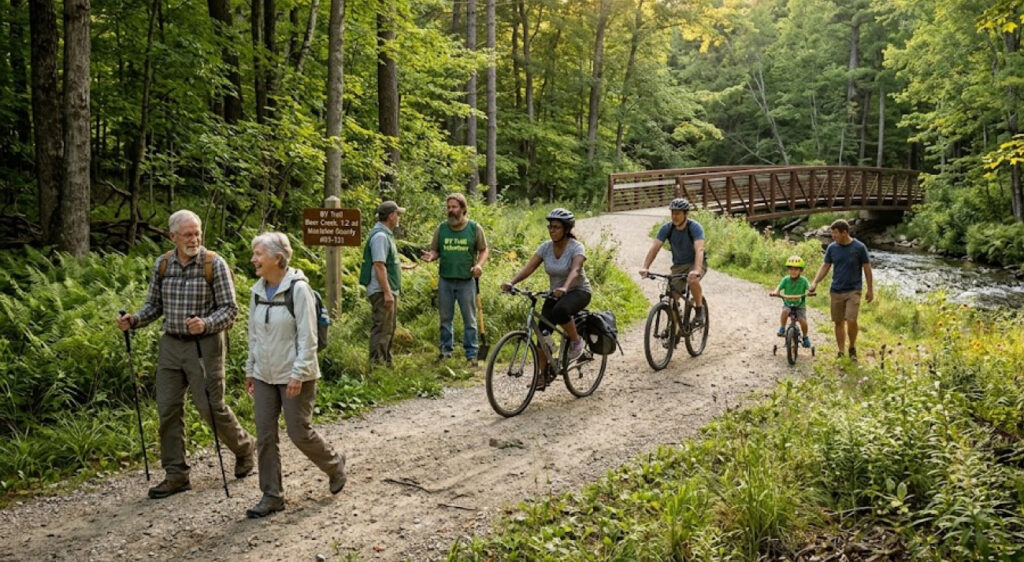
A New Connection Strengthens Michigan’s Northern Trail Network
A $1.75 million trail project in northern Michigan is creating a new connection between Thompsonville and Copemish, extending the Betsie Valley Trail and giving residents and visitors another year-round route for walking, bicycling, and other outdoor recreation.
Friends of SMARTrails will hold a ribbon-cutting ceremony on August 15, 2026, at 11 a.m. at the Copemish trailhead to mark completion of the Thompsonville-Copemish Trail Connector. The project resurfaced 3.4 miles of historic railroad corridor with crushed limestone and added a new bridge over Bear Creek in Springdale Township.
The investment brings together the Michigan Department of Natural Resources (DNR), U.S. Economic Development Administration, Manistee County Community Foundation’s Minger Family Endowment Fund, Networks Northwest, Friends of SMARTrails, Manistee County Recreation Commission, Little River Band of Ottawa Indians and other regional partners.
The project is significant beyond the physical trail itself. It adds another piece to a larger effort to connect communities through nonmotorized recreation infrastructure, preserve former transportation corridors, and give residents access to outdoor activities closer to home.
The Michigan DNR trail system identifies the Betsie Valley Trail as a 22-mile route following a former Ann Arbor Railroad corridor, with sections supporting biking, hiking, cross-country skiing, snowshoeing and seasonal snowmobiling.
The Thompsonville-Copemish Connector Completes A Key Gap
The new project focuses on a section of former railroad bed that had previously limited continuous recreational travel between Thompsonville and Copemish.
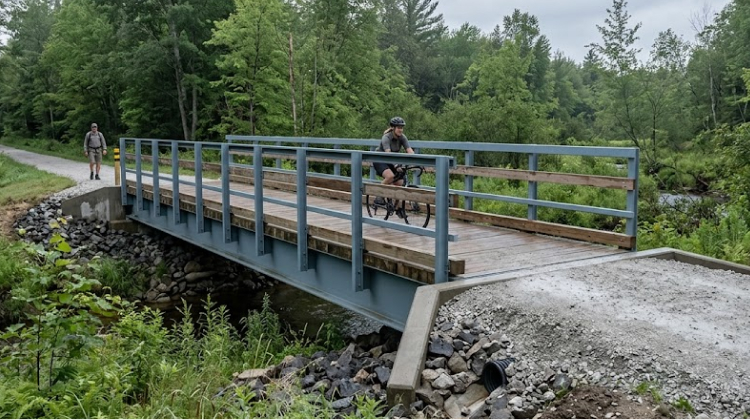
The 3.4-mile corridor has now been resurfaced with crushed limestone, creating a more consistent surface for nonmotorized users. The project also includes a new bridge over Bear Creek in Springdale Township.
The bridge has an additional seasonal role. It will accommodate snowmobiles during the winter, allowing the corridor to serve multiple recreational uses rather than functioning solely as a summer cycling or walking route.
| Project Feature | Details |
|---|---|
| Project | Thompsonville-Copemish Trail Connector |
| Investment | $1.75 million |
| New/Improved Trail | 3.4 miles |
| Surface | Crushed limestone |
| Major Structure | New Bear Creek bridge |
| Primary Communities | Thompsonville and Copemish |
| Major Partners | Michigan DNR, U.S. EDA, Networks Northwest, Friends of SMARTrails |
The project illustrates why former railroad corridors have become valuable recreation assets in Michigan. Their relatively direct alignments can connect communities while preserving a recognizable piece of local transportation history.
The Michigan Trails Network provides access to information about the state’s extensive network of hiking and outdoor recreation routes, showing how individual local projects contribute to a much larger public recreation system.
Federal And Local Funding Drive The Trail Investment
The $1.75 million price tag reflects a partnership model rather than a single-source investment.
Funding came from the U.S. Economic Development Administration and the Manistee County Community Foundation’s Minger Family Endowment Fund. Networks Northwest served as a co-applicant and project administrator, while Friends of SMARTrails played a central role in trail advocacy and regional coordination.
This funding structure is significant for rural recreation projects. Trail development can require substantial upfront costs for engineering, surface preparation, bridges, drainage, signage, property coordination and long-term maintenance.
A partnership between federal agencies, state government, foundations, nonprofit organizations and local recreation groups can distribute those responsibilities across multiple institutions.
The project also builds on earlier planning for a connected trail system throughout northern Manistee County. A 2022 report identified more than $1.7 million in combined grants supporting trail development in the region and described the goal of building a countywide multi-use network.
That history shows the Thompsonville-Copemish project is part of a longer recreation strategy rather than an isolated construction effort.
The Betsie Valley Trail Connects Communities Through Recreation
The Betsie Valley Trail already provides an important recreation corridor through northwestern Michigan.
The Michigan DNR describes the trail as a 22-mile route following the former Ann Arbor Railroad from Frankfort toward Mesick. The corridor passes through landscapes including Betsie Bay, the Betsie River, marshlands, hardwood forests and the Pere Marquette State Forest.
The addition of the Thompsonville-Copemish connection increases the potential for residents to use the trail as part of a longer regional recreation network.
That distinction matters for community recreation planning. A short neighborhood pathway can provide valuable daily activity, but connected trails can support longer cycling trips, walking excursions, family recreation and regional tourism.
The new connector gives Thompsonville and Copemish a stronger relationship with that broader system.
It also creates opportunities for residents who may not participate in organized recreation programs. A public trail requires no team registration, scheduled class, or specialized membership. People can walk, ride, explore, or use the corridor according to their own schedules.
Recreation Infrastructure Can Support Multiple Generations
The project’s year-round approach gives the trail relevance across different seasons and age groups.
During warmer months, the corridor can support walking, cycling and nature-based recreation. Winter use introduces another dimension through snowmobiling on the bridge and applicable sections of the broader trail network. The DNR currently identifies snowmobiling on portions of the Betsie Valley Trail from December 1 through March 31.
That multi-season model helps public recreation infrastructure deliver value beyond a short summer window.
Families can use trails for relatively low-cost outdoor activities. Older residents can benefit from walking routes, provided trail conditions and access points meet their needs. Cyclists can incorporate the route into longer regional rides, while visitors can use the corridor as part of a broader trip through northern Michigan.

The trail’s historic railroad origins add another educational dimension. Users experience a former transportation corridor that has been repurposed for recreation while still retaining connections to the region’s industrial and community history.
Thompsonville Is Building Around The Trail
The trail project is occurring alongside broader community efforts in Thompsonville.
The Thompsonville Area Revitalization Project (TARP) has been working on a long-term vision for a trailhead near the historic Thompsonville Junction. The organization describes the goal as creating an attractive destination for bicyclists, walkers and visitors while recognizing the area’s railroad history.
A separate trailhead development project includes plans for amenities such as restrooms, showers, picnic areas, drinking fountains, bicycle charging stations, bike parking and a repair station. The first phase received a $346,200 Michigan Economic Development Corporation grant, with the overall project previously estimated at approximately $800,000.
These projects demonstrate how trail infrastructure can influence community planning beyond the trail surface itself.
A trail becomes more useful when people have places to park, rest, obtain information, access water, repair bicycles, and connect with nearby businesses and community spaces. Thompsonville’s planning efforts position the trail as part of a larger local recreation and revitalization strategy.
New Trail Funding Is Continuing Across Northern Michigan
The Thompsonville-Copemish connector is one part of a broader wave of trail investment in the region.
On August 3, 2026, Benzie County received approval for a $1 million Transportation Alternatives Program grant to pave a 4.1-mile section of the Betsie Valley Trail in Weldon Township. The project will extend toward Thompsonville Junction, a historic railroad site being developed as a bicycle campground and trailhead pavilion.
The development creates an interesting regional connection. One project improves the Thompsonville-Copemish section in Manistee County, while another is improving the Betsie Valley Trail toward Thompsonville in Benzie County.
| Recent Investment | Location | Amount | Purpose |
|---|---|---|---|
| Thompsonville-Copemish Connector | Manistee County | $1.75 million | 3.4-mile resurfacing and Bear Creek bridge |
| Weldon Township Trail Project | Benzie County | $1 million | 4.1-mile paving project |
| Thompsonville Trailhead | Thompsonville | $346,200 grant | Visitor pavilion and recreation amenities |
Taken together, these projects point toward a more connected recreation system rather than separate municipal trails.
The Michigan Department of Transportation Transportation Alternatives Program has become one mechanism for supporting transportation projects that provide alternatives to conventional automobile travel, including pathways and other active transportation facilities.
Trail Connectivity Strengthens Community Recreation Planning
The larger significance of the investment is its contribution to connectivity.
Disconnected trails can limit how people use recreation infrastructure. A pathway may be attractive on its own but become substantially more useful when it connects to another community, park, trailhead, campground, or regional destination.
The Thompsonville-Copemish project addresses one of those gaps.
The new bridge over Bear Creek is particularly important because bridges can become expensive barriers to trail continuity. Once a safe crossing is established, the corridor can function as a more complete route instead of requiring users to stop or find an alternate road connection.
Friends of SMARTrails, which stands for Scenic Manistee Area Recreational Trails, has worked on trail advocacy, fundraising and maintenance as part of the regional effort. Other participating organizations include the Manistee County Recreation Commission, Little River Band of Ottawa Indians and Benzie-Manistee Snowbirds.
This type of cooperation gives the project a broader community foundation and creates opportunities for future connections.
A $1.75 Million Project Creates A Longer-Term Recreation Asset
The August 15 ribbon cutting marks the public celebration of a project that has been developing for several years.
The finished connector gives northern Michigan another recreation route while preserving a former railroad corridor for public use. Its crushed-limestone surface, Bear Creek bridge and seasonal multi-use approach provide a practical foundation for continued outdoor recreation in the region.
The investment also arrives as other sections of the Betsie Valley Trail receive new funding and planning attention. With projects in both Manistee and Benzie counties, the corridor is becoming part of a more coordinated approach to trail development.
For communities such as Thompsonville and Copemish, that means the benefits of recreation infrastructure can extend beyond exercise. Trails can connect residents, support local destinations, provide outdoor learning opportunities, and create another reason for visitors to spend time in northern Michigan communities.
The Thompsonville-Copemish connector shows how a former railroad corridor can become modern public recreation infrastructure through federal funding, state involvement, nonprofit leadership and local planning. As additional sections receive investment, the long-term opportunity is a more connected trail network that serves residents and visitors across northern Michigan.