

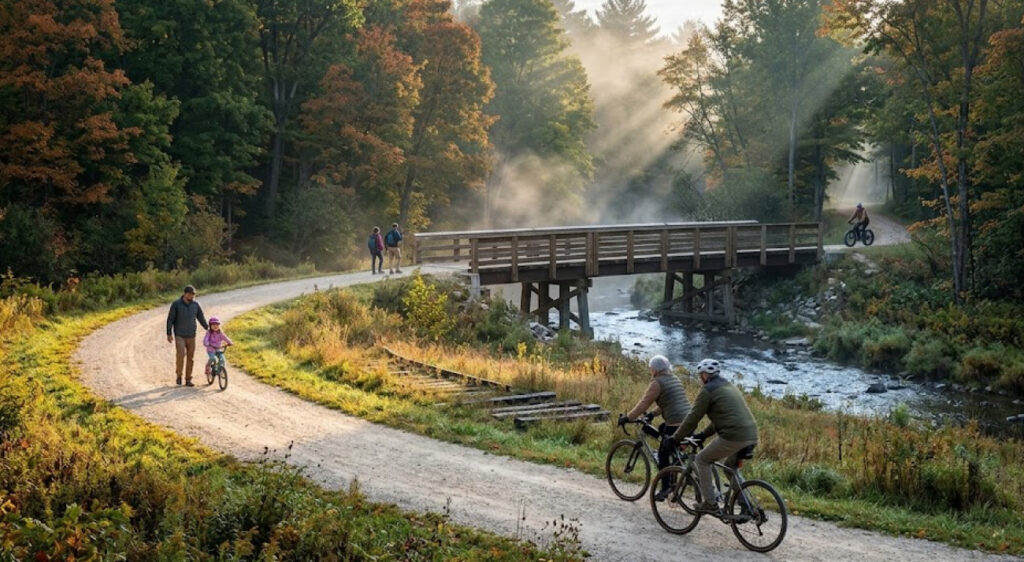
Michigan’s Thompsonville-Copemish Trail Connector is beginning to demonstrate how relatively small communities can use trail infrastructure to strengthen recreation access, community connections and year-round outdoor activity. The $1.75 million project connecting Thompsonville and Copemish in Manistee County includes 3.4 miles of resurfaced trail and a new bridge over Bear Creek, transforming a historic railroad corridor into a more usable regional recreation route. A ribbon-cutting ceremony on August 17, 2026, formally celebrated the completed connection, while local officials and trail advocates say the route has already attracted daily users.
The project is part of a much larger effort to build an interconnected trail system throughout Manistee County. Rather than treating the new segment as an isolated recreational amenity, local planners and Friends of SMARTrails are positioning it as another link in a network that can connect villages, support active transportation and create opportunities for cycling, walking and winter recreation. That approach aligns closely with the broader outdoor recreation research focus on how public infrastructure can influence community wellness and local development.
A $1.75 Million Investment In Regional Connectivity
The Thompsonville-Copemish project focuses on a section of historic railroad corridor that had significant potential for recreation but required substantial improvements before it could serve a wider range of users.
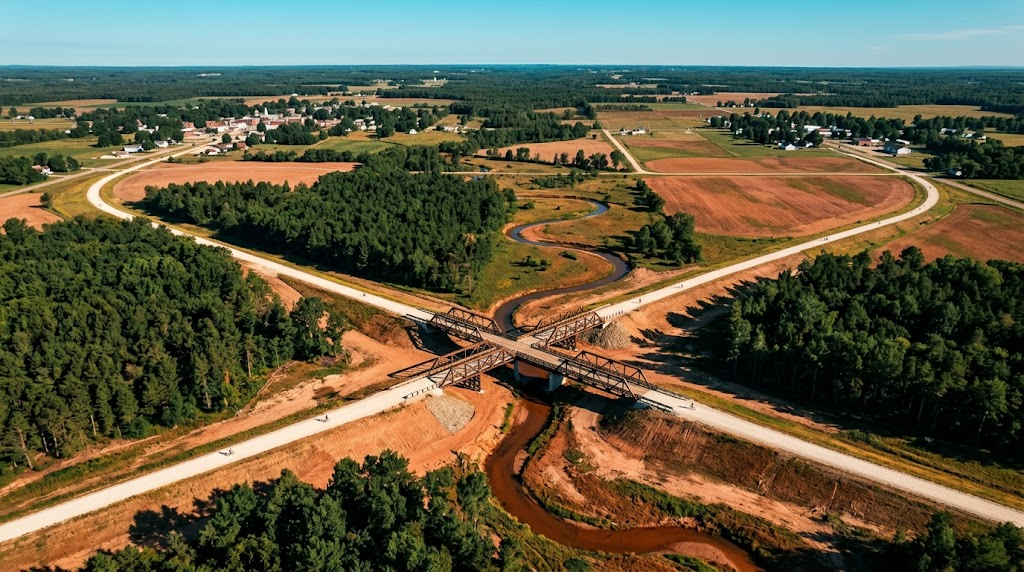
The completed work resurfaced approximately 3.4 miles with crushed limestone and constructed a new bridge over Bear Creek in Springdale Township. The improvements are designed to make the corridor more practical for walkers and cyclists while also supporting snowmobile use during the winter season.
The funding structure reflects the partnership-driven approach increasingly used for recreation infrastructure in smaller communities.
| Project Element | Thompsonville-Copemish Trail Connector |
|---|---|
| Project investment | $1.75 million |
| Trail improvement | 3.4 miles |
| Surface | Crushed limestone |
| Major structure | New Bear Creek bridge |
| Corridor | Historic railroad bed |
| Primary recreation uses | Walking, cycling and snowmobiling |
| Location | Manistee County, Michigan |
| Key organization | Friends of SMARTrails |
The project was funded through the U.S. Economic Development Administration and the Manistee County Community Foundation’s Minger Family Endowment Fund, with Friends of SMARTrails, the Michigan Department of Natural Resources, Networks Northwest and other organizations contributing to the effort.
That combination is significant because recreation projects in rural communities often depend on multiple funding sources rather than a single municipal budget. The Thompsonville-Copemish connector demonstrates how nonprofit advocacy, local foundations, state agencies and federal economic-development resources can combine around a shared infrastructure objective.
A Historic Railroad Corridor Becomes A Recreation Asset
One of the most important characteristics of the project is the corridor itself.
The trail follows an abandoned railroad bed, giving the project an opportunity to repurpose an existing transportation corridor rather than creating an entirely new route through undeveloped land. Michigan’s broader rail-to-trail experience shows how former railroad infrastructure can provide relatively direct routes between communities while preserving a connection to local history.
The Thompsonville-Copemish segment is associated with the Betsie Valley Trail system, a larger network extending through northern Michigan. The Michigan DNR identifies the Betsie Valley Trail as a route supporting biking, hiking, cross-country skiing and, on designated portions during winter, snowmobiling.
For the Thompsonville-Copemish section, the resurfacing work changes the practical character of the corridor. An unimproved railroad bed may be usable by experienced outdoor users, but a more consistent crushed-limestone surface expands the potential audience.
That distinction matters for public recreation planning.
A trail does not become broadly useful simply because a route exists on a map. Surface conditions, bridge crossings, signage, trailheads, parking and maintenance determine whether residents can realistically incorporate the trail into everyday recreation.
The connector addresses one of those fundamental barriers by improving the trail surface across a substantial continuous section.
The Bear Creek Bridge Closes An Important Gap
The new bridge over Bear Creek is another critical component of the project.
Before the improvement, the absence or condition of a bridge represented a physical obstacle within the broader trail network. Manistee County planning documents have identified the Bear Creek crossing as an important connection within the regional trail system and noted that the bridge would help restore continuity along the corridor.
The bridge has also been designed with winter recreation in mind. Local reporting indicates that it accommodates snowmobiles, allowing the corridor to remain useful beyond the traditional summer hiking and cycling season.
This is an important feature of Michigan trail planning because seasonal recreation can dramatically affect the value of infrastructure.
A trail that supports multiple activities throughout the year can serve residents during different periods rather than functioning primarily as a summer attraction. In Manistee County, that means the same corridor can support walking and cycling during warmer months and snowmobiling during winter.
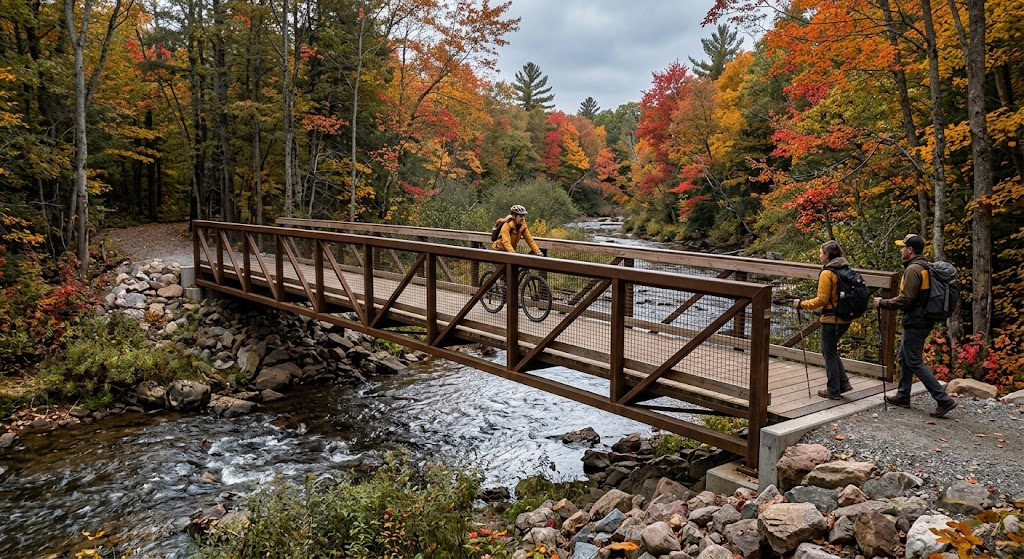
The approach also illustrates why bridges are often much more than individual construction elements in trail systems. A missing bridge can disconnect otherwise usable segments, while a new crossing can transform separate sections into a continuous route.
Early Use Provides A Practical Measure Of Demand
The most immediate evidence emerging from the project is local use.
Recent reporting from the Manistee News Advocate says the newly extended trail has quickly attracted daily users since opening earlier in the year. The August 17 ribbon-cutting brought attention to a facility that residents were already incorporating into their recreational routines.
Early use does not by itself provide a complete measure of a trail’s long-term success, but it offers an important early indicator.
Friends of SMARTrails has also been pursuing trail counters and usage-tracking equipment, according to Manistee County Recreation Commission records. That suggests the organization is interested in moving beyond anecdotal observations toward measurable information about how people use the network.
That distinction is valuable for recreation agencies.
Visitor counts can help answer questions about whether infrastructure is attracting new users, whether particular segments experience seasonal peaks and where future improvements should be prioritized. Over time, data can also support grant applications and help communities demonstrate the value of continued investment.
For an organization focused on community park planning, trail usage data can be particularly useful because recreation demand is often easier to demonstrate when agencies can document actual visits rather than relying only on projected participation.
Connecting Thompsonville And Copemish
The project has significance beyond the physical trail surface because it strengthens the connection between two small communities.
Thompsonville and Copemish are separated by rural landscapes where transportation choices can be limited. A dedicated recreation corridor provides a different form of movement between communities, particularly for people who are walking, cycling or participating in other nonmotorized activities.
The Manistee County-wide recreation planning effort has identified connected trails as a long-term priority. Friends of SMARTrails’ strategic planning documents specifically emphasize connectivity between communities and regional trail systems while identifying health, recreation, social and economic benefits as core objectives.
This changes how the $1.75 million investment can be evaluated.
The project is not simply about providing a place to exercise. It is also about creating a piece of connective infrastructure that can support social interaction, outdoor mobility and regional recreation.
That broader function is particularly relevant in rural areas, where individual communities may not have the population or resources to build large recreation complexes. A connected trail network can distribute recreational opportunities across several communities and allow residents to access destinations beyond their immediate neighborhoods.
Recreation Infrastructure Can Support Community Wellness
The health implications of the project are another reason the trail’s early use matters.
Walking and cycling are forms of physical activity that can be incorporated into everyday routines without requiring membership in a specialized facility. A safe, maintained trail can provide residents with an alternative to indoor exercise and create opportunities for families and individuals to spend time outdoors.
The project also fits into Manistee County’s stated recreation priorities. County planning documents identify health, recreation, social benefits and economic impacts as objectives for trail development. The same planning framework emphasizes trails designed for varied users and all-season activity.
That makes the Thompsonville-Copemish connector a useful example of infrastructure serving several policy objectives simultaneously.
A person using the trail for a morning walk may primarily see it as a wellness resource. A cyclist may view it as a transportation or recreation corridor. A snowmobiler may see it as part of a winter network. Local businesses may view increased trail activity as an opportunity to attract visitors.
The infrastructure remains the same, but its community value changes depending on how people use it.
Local Partnerships Make The Project Possible
The project’s development also illustrates the importance of partnerships.
Friends of SMARTrails, or Scenic Manistee Area Recreational Trails, has played a central advocacy and fundraising role. The nonprofit describes its mission around creating, promoting, maintaining and connecting trails in Manistee County and the broader Michigan trail system.
The Michigan Department of Natural Resources is another important partner because portions of the regional trail network fall under DNR ownership and management.
Networks Northwest has contributed to regional transportation planning, while local governments, foundations and contractors have helped move individual projects from planning to construction.
The partnership model also creates a mechanism for pursuing future segments.
Manistee County documents show that local officials and Friends of SMARTrails have been discussing additional connections, maintenance responsibilities, trail counters, signage and potential future funding.
The long-term challenge is therefore not simply completing one successful project. It is maintaining the infrastructure and finding the resources necessary to connect it with the next segment.
The Next Phase Extends Beyond Thompsonville And Copemish
The newly completed connector is being viewed as one stage in a larger regional vision.
Friends of SMARTrails has identified future trail-development opportunities connecting additional communities and corridors, while local planning documents continue to emphasize a countywide interconnected system. The organization has also identified future segments involving areas near Kaleva, Chief Road and other parts of Manistee County.
That strategy makes connectivity a cumulative process.
A single three-mile trail can provide meaningful recreation access, but its potential increases when it connects to another three miles, then another segment beyond that. Over time, a collection of individually funded projects can become a regional system.
Michigan’s broader trail planning also shows the importance of preserving these connections. MDOT recently described work on the Betsie Valley Trail as part of a long-term effort to improve mobility and connect communities through active transportation infrastructure.
For Manistee County, the challenge will be maintaining momentum while balancing land ownership, environmental considerations, maintenance requirements and competing infrastructure priorities.
Measuring The Long-Term Value Of The Connector
The Thompsonville-Copemish Trail Connector offers an immediate recreational benefit, but its larger impact will become clearer as usage data accumulates.
Trail counters, community feedback and seasonal participation records can help determine whether the investment is serving the range of users anticipated during planning. Those measurements can also identify where future improvements are most needed.
Maintenance will be equally important.
Crushed-limestone trails require ongoing management, bridges require inspection and upkeep, and winter use introduces different maintenance considerations than summer cycling and walking. Manistee County officials have already discussed maintenance agreements and long-term management responsibilities as part of broader trail planning.
That means the project’s success should ultimately be evaluated across several dimensions: use, accessibility, connectivity, maintenance, seasonal activity and community benefit.
The $1.75 million investment has created the physical infrastructure. The next phase is making sure that infrastructure remains connected, maintained and useful for the communities that supported its development.
For Thompsonville, Copemish and the surrounding Manistee County region, the new trail is therefore both a finished project and a starting point. Its early daily use provides evidence that residents are responding to improved recreation access, while the continuing regional planning effort shows that local leaders see trails as long-term community infrastructure rather than short-term amenities.