
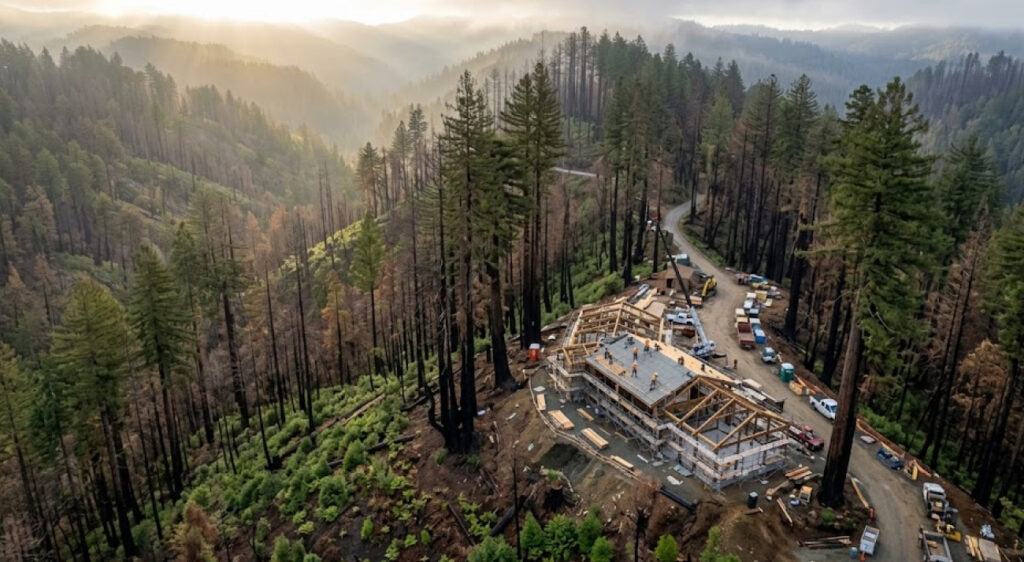
Big Basin Redwoods State Park has received a record $6 million donation from the Reyneri family of Los Altos to support the long-term rebuilding of California’s oldest state park following the devastation caused by the 2020 CZU Lightning Complex Fire. The contribution, made through Friends of Santa Cruz State Parks, is the largest donation in the nonprofit’s history and will fund construction of a new 2,400-square-foot Redwood Ecology Interpretive Center.
The donation arrives as California State Parks continues a rebuilding program estimated to require approximately $369 million. Less than half of that amount has been secured so far, making private philanthropy an important part of the financial structure behind the park’s recovery. The scale of the remaining need also illustrates why restoring Big Basin is a much longer process than simply replacing buildings destroyed by fire.
The Reyneri family’s contribution is connected to the memory of Cesare Reyneri, an avid outdoorsman, and is intended to help preserve Big Basin’s natural and cultural legacy for future generations. The new interpretive center will provide educational exhibits focused on the park’s ecology and history, giving visitors a new point from which to understand a landscape that has undergone one of the most consequential wildfire events in its history.
For visitors following the recovery, California State Parks’ Big Basin information shows that the park is currently open for limited day-use recreation, while camping remains unavailable and parking capacity remains restricted. The recovery is therefore happening alongside a gradual return of public access rather than after a complete reconstruction.
A $6 Million Donation Supports A Much Larger Recovery
The size of the Reyneri family’s donation is significant on its own, but its broader importance becomes clearer when compared with the total cost of rebuilding Big Basin.
The $369 million estimate covers a comprehensive rehabilitation program rather than a single construction project. The 2020 CZU Lightning Complex Fire destroyed or severely damaged much of the park’s developed infrastructure, including buildings, trails, campgrounds and other visitor facilities. Most of the ancient redwoods themselves survived, meaning the rebuilding challenge involves restoring visitor infrastructure within a forest that has undergone a profound ecological disturbance.
That distinction has influenced the direction of California State Parks’ planning. The future Big Basin is not simply expected to reproduce the park exactly as it existed before August 2020. Instead, the state has developed a plan that changes where and how some visitor facilities are located.
California State Parks’ rebuilding summary describes a future headquarters area with reduced paving and buildings, allowing portions of the former developed area to return toward old-growth forest conditions. A new visitor arrival area at Saddle Mountain is also planned, with a visitor center, café and store, while visitors would use a shuttle for access into the old-growth core.
This approach changes the financial equation. Rebuilding Big Basin requires funding for infrastructure, but the objective is also to create a park model that places greater emphasis on ecological protection, visitor education and transportation management.
The $6 million donation therefore fits into a larger transition in how the park is being reconstructed.
The Redwood Ecology Interpretive Center Will Become A Key Visitor Facility
The most direct destination for the Reyneri family’s contribution is the planned Redwood Ecology Interpretive Center.
At approximately 2,400 square feet, the center will be relatively modest compared with the overall rebuilding program, but its function is central to the future visitor experience. The facility is intended to provide exhibits explaining Big Basin’s ecology and history, allowing visitors to understand the forest before moving deeper into the park.
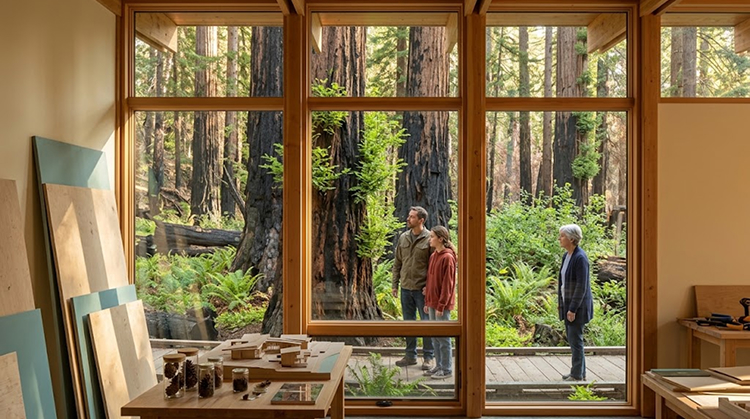
That educational role is particularly relevant after the CZU fire because Big Basin provides an unusual opportunity to observe how an ancient redwood ecosystem responds to a major wildfire.
Coast redwoods have characteristics that can help them survive fire, including thick bark and the ability to regenerate from surviving tissues. California State Parks now offers educational programming at Big Basin that specifically examines redwoods’ relationship with fire, their adaptations and how the forest is responding to the 2020 CZU Lightning Complex Fire.
The new interpretive center can make that science part of the physical visitor experience rather than leaving it solely to guided programs or temporary interpretation.
That matters because rebuilding a damaged park is also an opportunity to document what happened to the landscape. Visitors arriving years after the fire may otherwise see a recovering forest without fully understanding why certain areas look different, why infrastructure has been relocated or why some trails and facilities are no longer where they once were.
The center can provide that missing context.
For a park whose identity is inseparable from its ancient trees, the ability to explain forest ecology, wildfire, cultural history and restoration in one location becomes part of the park’s long-term infrastructure.
Big Basin Has Been A Conservation Landmark For More Than A Century
The rebuilding effort is taking place at a park with an unusually important place in California’s conservation history.
Big Basin was established in 1902, making it California’s oldest state park. The campaign to protect the area developed around concern over the logging of ancient coast redwood forests in the Santa Cruz Mountains.
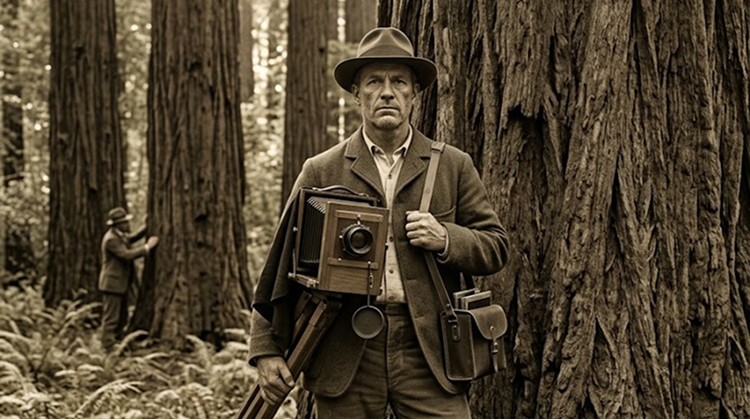
Photographer Andrew P. Hill played an important role in the early preservation movement after photographing redwoods in the region. Following a confrontation over his photographs, Hill became committed to protecting the trees. In 1900, he and other conservation advocates visited Big Basin, helping build momentum for a campaign to preserve the forest.
The resulting preservation effort eventually led California to establish the park. The history of Big Basin therefore predates the modern state park system in many ways: its creation helped establish a model for public conservation that would influence the development of parks throughout California.
The park expanded considerably over the decades. California State Parks describes Big Basin today as a landscape containing ancient coast redwoods along with forests, chaparral and coastal wetlands. A separate 153-acre NoraBella property was added to the park in February 2026, providing additional land adjacent to the planned rebuilding area. The property was acquired from Sempervirens Fund for $2.4 million and is expected to contribute to the future visitor gateway.
That recent land acquisition demonstrates that the park’s recovery is not limited to replacing what the fire destroyed. The state is simultaneously reshaping the physical footprint and visitor infrastructure of Big Basin.
For readers interested in how major parks recover after catastrophic wildfire, ITPR park recovery reporting provides additional context on the relationship between public recreation infrastructure, environmental restoration and long-term park management.
The Rebuilding Plan Moves Some Facilities Away From The Old-Growth Core
One of the most important aspects of the future Big Basin is the decision to change the relationship between visitor facilities and the oldest redwood areas.
Before the fire, the park headquarters and several developed areas were located within the forest. The rebuilding plan calls for a different approach, including reduced development in the former headquarters area and a new visitor arrival point at Saddle Mountain.
Visitors are expected to arrive at a new entrance area containing a visitor center, café and store before using a shuttle to reach the old-growth core. California State Parks’ plan anticipates a roughly 15-minute shuttle ride between the future gateway and the central redwood area.
This configuration has several potential effects.
First, it can reduce the amount of vehicle traffic penetrating the most sensitive parts of the park. Second, it can concentrate visitor services in a location where they can be designed as a coherent gateway. Third, it can create a more predictable transportation system for visitors who might otherwise drive directly into the redwood forest.
The tradeoff is that visiting Big Basin will require a different physical experience than it did before the fire.
That is an important consideration for a park rebuilding after disaster. Restoring access does not necessarily mean recreating every element of the previous visitor model. In Big Basin’s case, the rebuilding process is being used to reconsider how recreation, transportation and ecological protection should interact.
The $6 million interpretive-center donation fits naturally into that strategy because education becomes more important when the visitor journey is deliberately structured around interpretation and environmental stewardship.
The Forest Survived, But The Recreation Infrastructure Did Not
The CZU Lightning Complex Fire created an unusual contrast at Big Basin: many of the park’s iconic redwoods survived while much of the built environment did not.
That difference is important when assessing the recovery.
A mature redwood can represent centuries of ecological development. A visitor building, campground or bridge can be replaced over a much shorter period, although rebuilding those facilities to modern standards can still take years.
The park’s current restrictions demonstrate how much work remains. California State Parks currently lists no camping reservations, while day-use parking remains limited and reservations are recommended. The park is open from 8 a.m. to sunset, but visitors should expect a very different experience from the fully developed park that existed before the fire.
The distinction also affects trails.
Some areas are available for day-use recreation, while other portions of the historic trail network remain under restoration. The rebuilding of trails is complicated by erosion, damaged structures, vegetation changes and the need to design infrastructure for a landscape that is more vulnerable to future wildfire and extreme weather.
Big Basin’s recovery is therefore an infrastructure project embedded inside a living ecosystem.
That makes the choice of materials, locations, transportation systems and visitor capacity especially important. A new facility can be built quickly compared with the lifespan of a redwood, but its effects on the surrounding landscape can last for decades.
Private Philanthropy Is Filling An Important Part Of The Funding Gap
The Reyneri family’s $6 million contribution is also a reminder of the role private organizations have historically played in supporting California’s public parks.
Friends of Santa Cruz State Parks has worked with California State Parks on recovery and visitor programs in the region, while other organizations maintain dedicated funds for Big Basin’s restoration.
California State Parks currently identifies several nonprofit partners supporting the recovery. The Mountain Parks Foundation has established a Big Basin Recovery Fund, while Sempervirens Fund maintains a Big Basin’s Future Fund. The Save the Redwoods League also operates a wildfire fund supporting restoration and work intended to accelerate the reopening of Big Basin.
This network matters because the state’s estimated rebuilding requirement is substantially larger than any single philanthropic contribution.
A $6 million donation represents only a portion of the $369 million recovery estimate, but it can unlock a specific project, provide matching opportunities or demonstrate private confidence in the broader restoration effort.
The interpretive center is particularly well suited to philanthropic support because it provides a visible, long-lasting public benefit. Donors can contribute to a facility that directly connects visitors with the ecology and history of the park while the state focuses additional resources on roads, trails, utilities, campgrounds and other core infrastructure.
That division of responsibility can help distribute the financial burden across government, nonprofits and private donors.
It also makes the recovery less dependent on a single source of funding.
The Future Park Will Need To Balance Access And Resilience
Big Basin’s reconstruction raises a larger question for public recreation: how should a park be rebuilt after a wildfire when the same conditions that caused the disaster may become increasingly common?
The answer emerging at Big Basin is a combination of ecological restoration, relocated facilities, visitor transportation and improved interpretation.
The park’s future campgrounds are planned around the edges of the old-growth forest rather than reproducing all of the former camping areas inside sensitive forest zones. Some former campground areas, including Blooms Creek, Sempervirens and Wastahi, are proposed for restoration to old-growth habitat. Other sites are planned to provide a mixture of car camping, cabins, group sites, walk-in sites and trail camps.
That approach suggests that resilience is being treated as a design principle rather than an afterthought.
A rebuilt campground must be accessible enough to serve visitors while being positioned and designed with future fire conditions in mind. A visitor center must accommodate public demand without creating unnecessary pressure inside the most sensitive redwood areas. Trails must provide meaningful access while accounting for erosion, wildfire recovery and changing environmental conditions.
The rebuilding process will therefore be judged by more than how quickly facilities return.
Its longer-term measure will be whether Big Basin can offer public recreation while reducing some of the vulnerabilities exposed by the 2020 fire.
The $6 Million Gift Gives The Rebuilding Effort A Visible Milestone
The Reyneri family’s record donation does not solve Big Basin’s entire rebuilding challenge. The remaining financial requirement is still substantial, and major pieces of infrastructure will require years of planning, funding and construction.
What the contribution does provide is a concrete milestone.
A 2,400-square-foot Redwood Ecology Interpretive Center gives the broader recovery a clearly defined project that visitors will eventually be able to see and use. It also reinforces an important principle behind the new Big Basin: rebuilding the park is about explaining and protecting the landscape as much as it is about replacing facilities.
The park’s history makes that especially meaningful. Big Basin began as a conservation achievement in 1902, survived decades of changing recreation patterns and entered the 2020 wildfire as one of California’s most recognizable redwood destinations. Its current recovery is now creating another chapter in that history.
The state is rebuilding trails and visitor infrastructure while also changing where some facilities will be located. New land has been added to the park. Nonprofit organizations are raising money for restoration. Educational programs are already introducing students and visitors to the forest’s post-fire recovery. And the Reyneri family’s $6 million commitment is now funding one of the future park’s key interpretive facilities.
Big Basin’s reopening will therefore be more than a return to the past. It will represent a redesigned relationship between visitors, infrastructure and an ancient forest that survived one of the most destructive fires in its history.
The work ahead remains extensive, but the new interpretive center provides a tangible example of what the next generation of Big Basin can look like: a public recreation facility built around the ecological story of the redwoods rather than separated from it.