

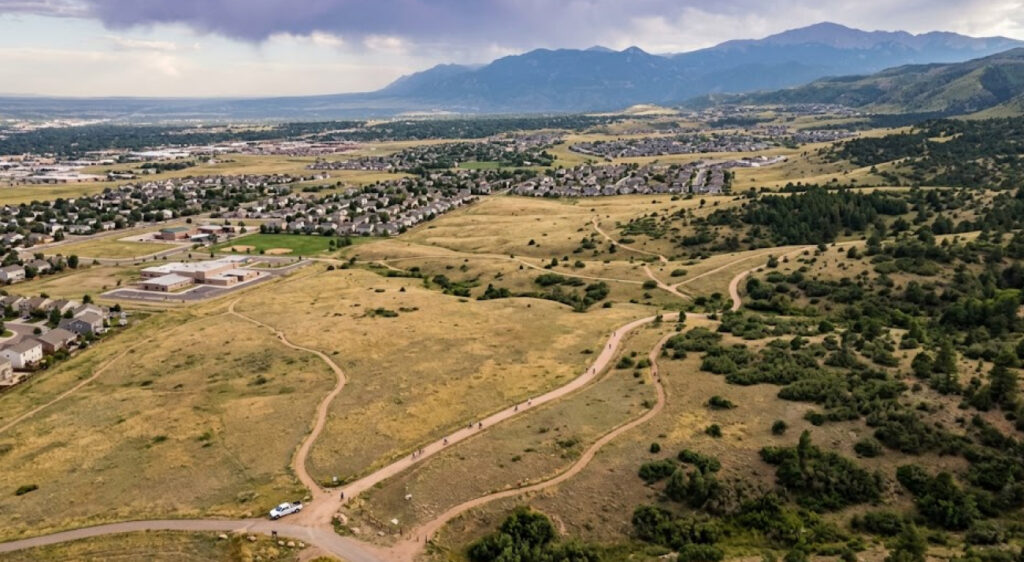
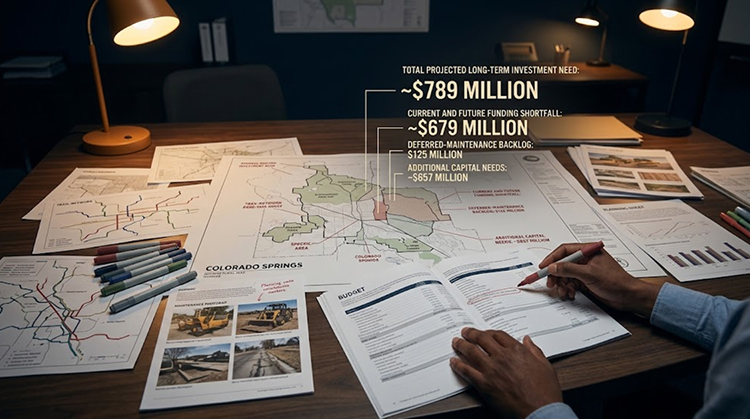
Colorado Springs is preparing for a major reset of its parks, trails and open-space system as city officials release a new long-term plan calling for roughly $789 million in investment through 2040. The draft Park System Master Plan comes as Colorado Springs anticipates more than 80,000 additional residents over the next 15 years, creating new pressure on an outdoor system that already serves millions of visits each year.
Released in early September 2026 by the city’s Parks, Recreation and Cultural Services Department, the draft replaces the city’s 2014 master plan and shifts much of the discussion away from simply building new amenities. The central issue is how Colorado Springs can maintain the infrastructure it already owns while preparing for population growth, expanding recreation access and protecting open space.
The planning process took roughly 18 months and included input from more than 5,500 community members. The resulting document identifies a substantial funding challenge: the city currently faces an estimated $679 million shortfall between available resources and the investments identified in the plan. Public comments are being accepted through September 22, 2026, before the proposal moves through additional review.
The scale of the proposal makes Colorado Springs one of the more significant municipal parks stories in the United States this fall. It also raises a larger question for growing American cities: how much outdoor infrastructure can communities realistically maintain when population growth increases demand faster than public funding.
A Growing City Is Putting More Pressure On Its Parks System
Colorado Springs already operates an unusually extensive recreation network. Recent city data cited during the master-planning process places the system at more than 19,000 acres of parks and open space and approximately 326 miles of trails.
That system includes neighborhood parks, regional open spaces, athletic facilities, playgrounds, golf courses, community centers and major destinations such as Garden of the Gods and Pikes Peak.
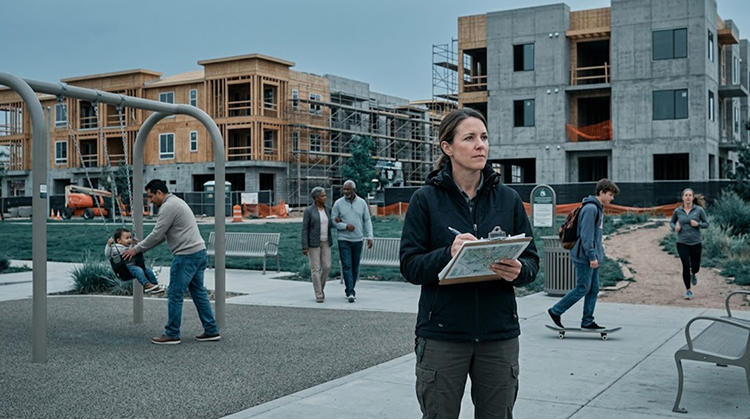
The city recorded approximately 22.5 million visits across its parks, open spaces and trails, according to recent Parks Department data. Garden of the Gods alone accounted for approximately 3.7 million visits, demonstrating how heavily outdoor resources are used by both residents and visitors.
The system also supports a significant volunteer network. More than 135,000 volunteer hours were recorded, representing an estimated $5.2 million in service value.
These numbers help explain why the new master plan is about more than adding new parks. A larger population means more trail wear, more demand for athletic fields and playgrounds, greater maintenance requirements and increased pressure on natural areas.
The city is therefore trying to plan for growth without allowing its existing recreation infrastructure to deteriorate.
For broader context on the economic and community role of municipal outdoor spaces, the Trust for Public Land’s 2026 ParkScore data provides a national comparison of America’s largest city park systems.
The $789 Million Figure Reflects A Long-Term Maintenance Challenge
The headline figure is substantial, but the proposed $789 million should not be interpreted as a single construction project or a single-year budget.
The draft plan divides its strategy into four broad phases covering the period from 2027 through 2040. The first phase, scheduled for 2027–2029, focuses on establishing the financial, organizational and asset-management foundation needed for the rest of the program.
The second phase, covering 2030–2034, is intended to stabilize the system through major maintenance and capital investment. The third phase, from 2035–2039, emphasizes expanded recreation opportunities and improved trail connections. The final phase focuses on larger transformational investments while maintaining long-term financial sustainability.
The numbers behind the proposal show why the city is emphasizing maintenance.
The draft identifies an estimated $125 million deferred-maintenance backlog alongside approximately $657 million in additional capital investment needs. Together, those figures account for most of the roughly $789 million long-term investment requirement.
The plan also estimates an annualized funding gap of approximately $52.2 million.
That distinction is important. Colorado Springs is not simply proposing to build hundreds of millions of dollars worth of new recreational facilities. A significant portion of the money would be needed to keep existing assets functional, safe and usable.
The Colorado Springs Park System Master Plan information describes the draft as a framework for maintaining existing assets, responding to growth, expanding recreation opportunities and protecting natural and cultural resources.
Existing Parks Are Becoming The First Investment Priority
One of the clearest changes from the city’s 2014 master plan is the emphasis on reinvestment.
The earlier plan generated a long list of projects that resulted in new neighborhood parks, open-space acquisitions and trail improvements. According to reporting by The Gazette, approximately 85% of that previous plan has been realized.
The new document takes a more operational approach.
Instead of assuming that additional facilities automatically represent progress, the plan recognizes that every new park also creates a permanent maintenance obligation. New trails require inspection and repair. Playgrounds require replacement. Restrooms require utilities and upkeep. Athletic fields need regular maintenance. Natural areas require monitoring and stewardship.
That creates a difficult equation for Colorado Springs.
The city’s park system has nearly doubled in size since 2000, while General Fund support has remained relatively flat after adjusting for inflation. The draft estimates that maintaining the same level of service provided in 2000 on a per-capita basis would require approximately $30 million to $33 million annually, compared with the current $17.1 million General Fund allocation.
The gap is therefore structural rather than temporary.
As the city grows, the cost of maintaining its outdoor infrastructure grows with it.
Trails Are Emerging As Critical Urban Infrastructure
The 326-mile trail network gives the master plan another important dimension.
Trails in Colorado Springs serve recreational users, but they also connect neighborhoods to parks, schools, open spaces and regional destinations. That makes trail planning increasingly relevant to public health, active transportation and daily mobility.
Bike Colorado Springs has already called for urban trails to be treated as vital transportation infrastructure, rather than being viewed solely as recreational amenities.
That distinction could become increasingly significant as Colorado Springs adds tens of thousands of residents.
A neighborhood trail that connects a residential area to a park can support walking and cycling while reducing dependence on short vehicle trips. At the same time, regional trails can distribute recreational use across a broader geographic area, potentially reducing pressure on heavily visited destinations.
The challenge is maintaining those connections.
A trail system is only useful when surfaces remain safe, crossings function properly, drainage is managed and connections are understandable to users. Deferred maintenance can therefore affect the usefulness of the entire network even when only individual segments are damaged.
This makes the proposed investment in trail connectivity part of a larger infrastructure strategy rather than simply an outdoor recreation upgrade.
Funding Remains The Biggest Question
Colorado Springs already has an established funding mechanism for acquiring and protecting open space through the Trails, Open Space and Parks, or TOPS, sales tax program.
Voters originally approved TOPS in 1997, and the program generates approximately $12 million annually, according to The Gazette. Voters later reaffirmed the tax through 2045.
However, TOPS does not solve the broader maintenance problem.
Advocates have argued that the program has historically been more effective at acquiring open space than funding the ongoing maintenance required after those properties become part of the public system.
The city’s General Fund provides another major source of support, but that allocation has not kept pace with the growth of the system.
The result is a funding structure that can help Colorado Springs acquire land while leaving officials with a more difficult question afterward: how will the city pay to maintain what it already owns?
That question will likely become one of the central political issues surrounding the master plan.
Residents appear to recognize the problem, but support for increased spending is not universal. Axios reported that survey results showed roughly half of residents supporting increased spending on open space, while 65.8% of survey respondents supported additional funding for repairs or open-space and trail protection.
The difference suggests that residents may support maintenance investment more strongly than broad tax increases without clearly defined priorities.
Park Quality Is Becoming A Competitive Issue For Colorado Springs
The investment debate also comes as Colorado Springs compares itself with other major American cities.
The Trust for Public Land’s 2026 ParkScore places Colorado Springs at No. 66 among the 100 largest U.S. cities, with a score of 52 out of 100. The ranking evaluates acreage, access, investment, amenities and park-space equity.
According to TPL, approximately 77% of Colorado Springs residents live within a 10-minute walk of a park.
The relatively low overall ranking therefore does not mean that the city lacks parks. Instead, it highlights the difference between having substantial acreage and operating a fully supported municipal park system.
Investment is particularly important in that comparison.
TPL’s 2026 analysis also shows that Colorado Springs had an estimated $104 in annual public park and recreation investment per resident, compared with an average of $196 among the cities included in the organization’s economic-benefit analysis.
That creates an important benchmark for the master plan.
Colorado Springs already has a large outdoor footprint. The question is whether future investment can bring the quality, accessibility and maintenance of that system closer to the expectations created by the city’s reputation as an outdoor destination.
Parks Also Deliver Measurable Economic And Health Value
The proposed spending debate cannot be separated from what the park system already contributes to Colorado Springs.
Recent city figures indicate that approximately 715,000 people participate annually in parks and recreation programming. The city’s Parks, Recreation and Cultural Services department has estimated $10.1 million in sales-tax generation associated with those activities, along with approximately $91.1 million in recreation value generated by residents using the city’s outdoor spaces.
The economic argument extends beyond direct recreation spending.
The Trust for Public Land’s 2026 research found that, across the cities included in its economic-benefit analysis, every dollar invested in parks and recreation generated at least $3 in annual local economic benefits.
Those benefits can include improved public health, lower health-care costs, consumer spending, environmental benefits and increased economic activity.
For Colorado Springs, that makes park investment more than a question of landscaping, playgrounds or trail surfaces. It is also a discussion about whether public outdoor infrastructure can help manage the costs associated with growth.
The Trust for Public Land’s Colorado Springs ParkScore profile provides a useful benchmark for examining the city’s access, acreage, investment, amenities and equity indicators alongside the new master-plan proposals.
Public Input Will Help Determine What Happens Next
The $789 million proposal remains a draft rather than an approved spending package.
Residents can submit comments through September 22, 2026, while the Parks Advisory Board and City Council will have opportunities to review the document later in the year.
The city has also scheduled community open houses. One is set for September 10 at Piñon Valley Park, with another scheduled for September 16 at Parks, Recreation and Cultural Services headquarters at 1401 Recreation Way.
That public process matters because the master plan will eventually influence which parks receive investment, where trail connections are prioritized, how open-space acquisitions are approached and which maintenance problems receive attention first.
For Colorado Springs residents, the most consequential part of the proposal may therefore be less about the $789 million headline and more about the priorities beneath it.
The city has already built an extensive recreation network. It has millions of annual park visits, hundreds of miles of trails, major natural destinations and a large volunteer base.
The next phase is about determining how that system can remain functional as the population grows.
The city’s experience also mirrors a broader trend across American communities: acquiring outdoor space is only the beginning. Long-term value depends on maintaining trails, protecting natural areas, replacing aging infrastructure and ensuring residents can actually reach and use those spaces.
Colorado Springs now has a 2040 framework that puts those responsibilities on the table. Whether the city can close the funding gap will determine how much of that vision becomes physical reality.