

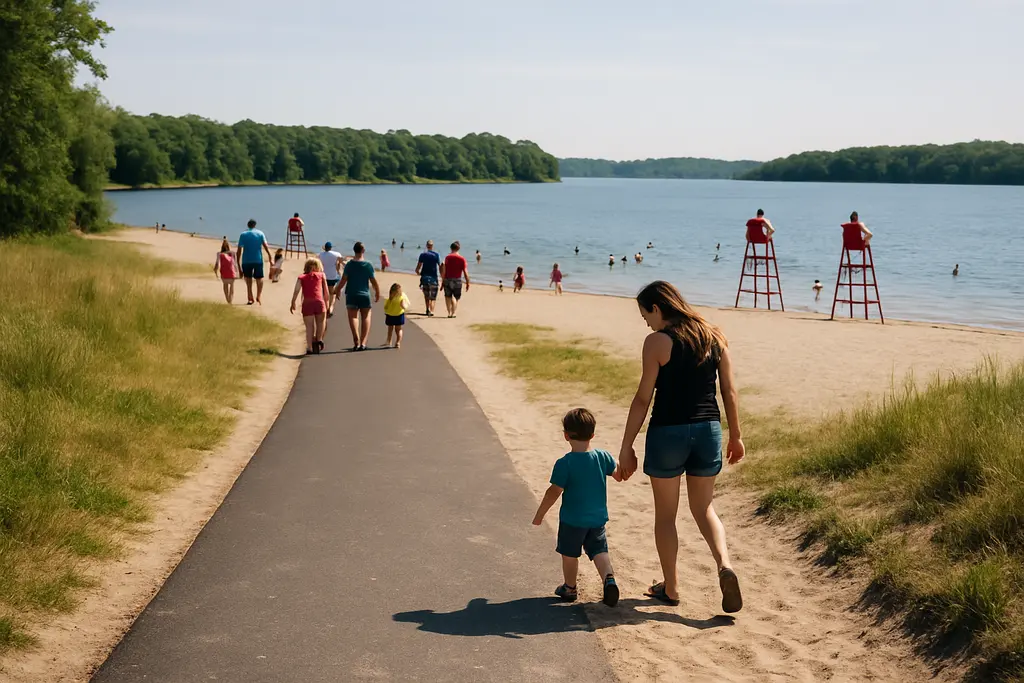
Big Lagoon Safety Upgrades shifted from planning into construction at Big Lagoon County Park in Humboldt County after the County announced that work began on May 5, 2025, supported by a $400,000 grant through California’s Proposition 68 Per Capita Grant Program, according to the County project notice. The County described the work as an ADA compliance project focused on improving access in the day-use area and campground. Because the supplied official materials identify construction details, dates and related health advisories, but do not provide a later confirmed completion notice or a current public meeting date, residents reviewing the project in 2026 have a practical task: compare what the County said would change with what park users now encounter on site.
How Big Lagoon Safety Upgrades Changed Access
The County’s official framing was accessibility compliance, not a stand-alone safety program. Still, the listed improvements have clear relevance for safe public use because they address routes, warnings, restroom access, parking and visitor information. In park and recreation planning, those features matter because a person’s ability to reach a restroom, identify a curb transition, park near a facility or find a stable picnic area can affect whether a public park is usable for people with mobility, vision or endurance limitations.
Big Lagoon Safety Upgrades In The Day-Use Area
The County said day-use work would include new concrete pathways and curbs with detectable warning systems. It also identified added accessible parking, including RV-sized stalls, accessible picnic and seating areas, remodeled restrooms with accessible stalls, and an outdoor rinsing shower. Those elements are specific and measurable. Residents reviewing the work can look for whether routes connect logically from parking to restrooms, picnic areas and shoreline-facing facilities, and whether detectable warnings are placed where grade changes or route transitions require clear notice.
Big Lagoon Safety Upgrades are most useful to residents when they reduce uncertainty at common decision points. A visitor arriving with a mobility device, a cane, a stroller or limited stamina needs to know where to park, how to reach a restroom, and where an accessible seating or picnic area is located. The County’s listed improvements suggest that the project was intended to address those basic use patterns rather than add a single isolated feature.
Campground Access Changes
For the campground, the County said the project would add accessible parking adjacent to restrooms. It also said pathways would connect campsites to restrooms with detectable warning surfaces, and that accessible campsite amenities would include new picnic tables, fire pits and electrical plug-in boards. The campground details are significant because access barriers often appear between facilities, not only at the facilities themselves. A restroom can be remodeled, but it remains difficult to use if the path from a campsite is uneven, unclear or disconnected.
The County also said the park would remain open during construction. Its May 2025 notice stated that restrooms were expected to close in late September 2025 to avoid disruption during peak summer use, and that the project was anticipated to be completed by early November 2025. The supplied research does not include a later official confirmation that the early November 2025 target was met, so any discussion of final conditions should be based on a current County update or a direct site review.
What The County Said Would Change
County planning materials cited in the supplied research identified a broader rehabilitation and access improvement effort that included replacing four existing single-post signs with three wooden information kiosks. The stated purpose included adding content to clarify regulation boundaries between the County Park and the adjacent State Park. The same materials described the County Park as approximately 7.5 acres and the adjacent State Park as approximately 250 acres, with visitor confusion tied to the larger 3.5-mile barrier beach area.
Why Boundary Signage Matters
Clear boundary information is a basic public-service issue. If visitors believe the entire barrier beach operates under one set of rules, compliance can become harder for both users and staff. The County’s planning materials, as summarized in the research, connected the proposed kiosks to clearer information about where County Park regulations apply and where adjacent State Park rules apply. That does not make signage a substitute for staffing, maintenance or enforcement, but it can reduce avoidable confusion.
The same planning materials described project-area disturbance at about 2,800 square feet of new concrete and roughly 10,000 square feet of total area disturbance including grading. Restroom footprints were described as approximately 360 square feet each, with no footprint change. These figures help residents evaluate scale. The project was not described as a large park expansion; it was described as targeted access work in existing public-use areas.
Accessibility As A Public Program Obligation
The County tied the work to its broader commitment to ensuring that public programs and facilities comply with the Americans with Disabilities Act. That matters because ADA compliance is not only a construction checklist. It affects whether residents can use public assets that are funded, managed or operated for community benefit. In that sense, Big Lagoon County Park’s improvements should be assessed by the continuity of access across the whole visitor experience, from arrival to restroom use to campsite or picnic-area access.
Water Advisories Added A Separate Safety Context
Access improvements were not the only safety-related issue documented for Big Lagoon in 2025. The supplied research states that Big Lagoon was under a safe-water advisory on August 15, 2025, after one of four sampled locations exceeded the “Danger” threshold for cyanobacteria toxins. The research also states that residents were warned to avoid water contact until toxin levels dropped. That advisory was separate from the construction project, but it affected how residents could safely use the park environment during the same general period.
Cyanobacteria Advisories In 2025
On October 9, 2025, harmful algal bloom advisories were lifted for Big Lagoon after multiple blooms had been detected from late July through mid-September, and the County reported that later sampling showed levels below actionable thresholds, according to the October 9 County alert. The same alert said one July 22, 2025 sample exceeded the “Danger” threshold by nearly 10 times. Those details show why water-quality notices should be treated as part of the park’s safety information system, even though they arise from environmental health monitoring rather than ADA construction.
For residents, the practical point is that physical access and water-safety communication should work together. A new path can improve access to a day-use area, but safe use also depends on timely posted information when water contact is not advised. The research does not state whether new kiosks include water-quality messaging, so residents should avoid assuming that construction signage and environmental health alerts are managed through the same channel unless the County states that directly.
Where Resident Input Can Be Most Useful

The topic of community input should be handled with care because the supplied official materials do not identify a specific future hearing, open house or comment deadline after the May 2025 construction notice. That means residents should not be told that a meeting is scheduled unless Humboldt County publishes one. Still, resident observations can be useful when they are specific, dated and tied to the features the County said it planned to build.
Resident Questions For County Review
Residents, campground users and accessibility advocates can focus comments on verifiable questions rather than broad impressions. Useful questions include whether accessible stalls are clearly marked and usable, whether pathway slopes and surfaces function as intended, whether detectable warnings are placed at appropriate transitions, whether restrooms reopened as expected after the late September 2025 closure period, and whether boundary information distinguishes the County Park from the adjacent State Park in plain terms.
- Are accessible parking stalls, including RV-sized stalls, located close enough to the day-use and restroom areas identified by the County?
- Do campground paths connect representative campsites to restrooms without abrupt gaps or unclear transitions?
- Do the information kiosks clearly explain County Park and State Park boundaries?
- Are water-quality advisories easy to find when harmful algal bloom risks are present?
For readers comparing how counties present park access, health and infrastructure notices, countywatchers.com delivers county-level civic coverage that can provide a useful reference point for asking clearer local questions. For Big Lagoon, the strongest public feedback will cite the County’s own stated scope and identify any gaps between the stated plan and current conditions.
What Big Lagoon Safety Upgrades Mean For Park Users
Big Lagoon Safety Upgrades should be evaluated as a set of connected public-use changes: accessible routes, restroom work, campground amenities, parking, visitor information and water-safety communication. The County’s documented project scope points to meaningful access improvements, while the 2025 harmful algal bloom advisories show that safe park use also depends on environmental health alerts that may change over time. As of August 27, 2026, the most evidence-based next step for residents is to rely on current Humboldt County notices, compare them with on-site conditions, and provide precise feedback if any promised access or information feature is missing, unclear or difficult to use.