

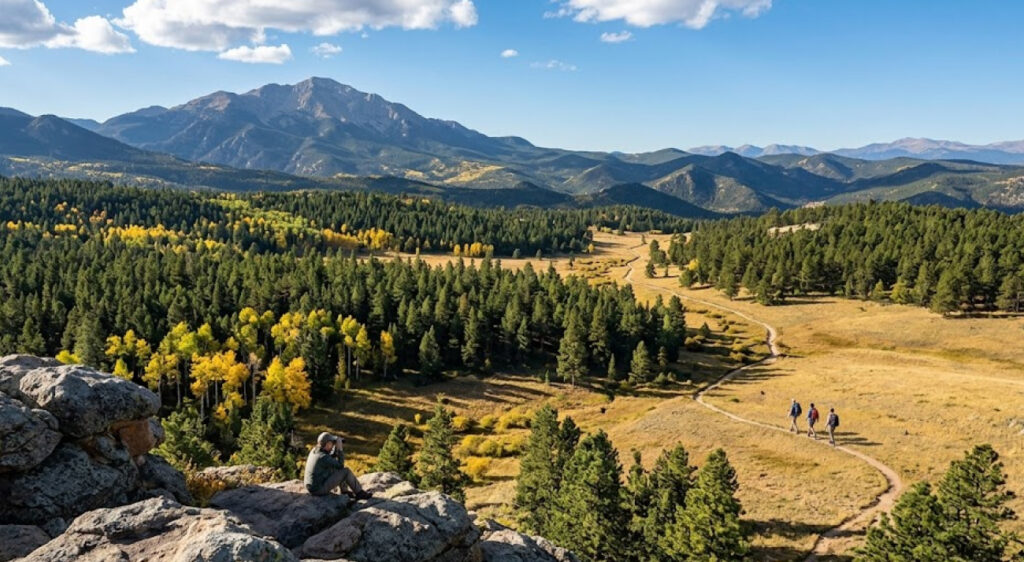
Colorado’s Pikes Peak region has gained a significant new piece of protected open space after Palmer Land Conservancy acquired 674 acres at Pinestone Ranch near Woodland Park. Announced on August 11, 2026, the acquisition protects a largely undeveloped mountain landscape on the northern flank of Pikes Peak and establishes a long-term goal of creating public outdoor recreation opportunities for the surrounding community. The property is not yet open to visitors, but Palmer says the land is intended to become publicly accessible after additional planning, fundraising, permanent protection and infrastructure work are completed.
The project is significant because it approaches recreation access from a different direction than conventional park construction. Instead of adding facilities to an existing recreation site, the conservation effort protects a large undeveloped landscape before development can permanently change its character. The strategy links land conservation, future public access, wildlife habitat and regional trail connectivity, creating an example of how communities can plan recreation capacity years before a park officially opens.
For the broader Pikes Peak region, Pinestone Ranch also represents a rare opportunity. Palmer describes the property as one of the last large undeveloped tracts between Colorado Springs and Woodland Park, while the organization says the property connects to approximately 100,000 acres of public lands and sits near thousands of acres of protected ranchland.
A 674-Acre Property Protected From Development
Pinestone Ranch sits on the northern flank of Pikes Peak near Woodland Park in Teller County. The property contains conifer and aspen forests, meadows, ridgelines and creek corridors, creating a landscape that differs substantially from the increasingly developed areas surrounding Colorado’s Front Range.

The acquisition is particularly notable because the property had been marketed for potential development. According to local reporting, the 674-acre ranch had been listed at $5.9 million as a potential development property before Palmer acquired it. The conservancy has not disclosed the final purchase price.
That distinction matters when evaluating the project’s recreation implications. The organization did not simply purchase an existing public park. It intervened at a point when the land could have moved toward private development and instead acquired the property with the stated intention of eventually creating public open space.
Palmer’s acquisition also marks a change in the organization’s traditional approach. The conservancy says this is its first acquisition on this scale specifically intended for future public access, rather than simply holding a conservation easement while another owner retains the property.
The result is a project where conservation precedes recreation infrastructure.
| Pinestone Ranch At A Glance | Details |
|---|---|
| Protected acreage | 674 acres |
| Location | Northern flank of Pikes Peak near Woodland Park, Colorado |
| County | Teller County |
| Acquiring organization | Palmer Land Conservancy |
| Announcement | August 11, 2026 |
| Previous listed price | $5.9 million |
| Current public access | Not yet open |
| Long-term objective | Public open space and outdoor recreation |
| Major landscape features | Forest, meadow, ridgeline and creek corridors |
The acquisition therefore establishes the land base first. The public recreation component will follow through a separate planning process.
Why Future Recreation Starts With Land Protection
Protecting land before building trails or facilities can give communities greater flexibility over how recreation develops.
Once a large undeveloped property is divided into residential lots, roads and private infrastructure, creating a continuous public recreation corridor becomes significantly more difficult. Conservation acquisitions can preserve that flexibility by maintaining the underlying landscape while planners determine where trails, access points and other facilities should eventually be located.
This is especially relevant along Colorado’s Front Range, where population growth and development pressure have increased demand for both housing and outdoor space.
Palmer’s broader conservation work illustrates the scale of this challenge. The organization says it has protected 138,000 acres since 1977, including public parks, open spaces, working farms and ranches, and scenic landscapes.
The Palmer Land Conservancy conservation work also places Pinestone Ranch within a larger strategy focused on connecting land protection with the quality of life in southern Colorado.
For recreation planners, the important question is not simply how many acres are protected. It is whether protected properties can eventually function as connected, usable landscapes for residents.
Pinestone Ranch has characteristics that make that possibility particularly relevant.
Wildlife Protection And Recreation Can Share The Same Landscape
Outdoor recreation is only one reason the property is being protected.
Palmer says Pinestone Ranch provides habitat for 63 species of conservation interest, including nearly half of Colorado’s highest-priority mammal species and approximately one-quarter of its highest-priority bird species. Those figures come from the conservancy’s assessment of the property and should be understood as organization-reported conservation data.
The challenge for future planners will be balancing public access with those ecological values.
Opening every part of a protected landscape to unrestricted recreation would not necessarily produce the best conservation outcome. Trails may need to avoid sensitive habitat, seasonal restrictions could be necessary, and infrastructure could need to be concentrated in areas capable of handling higher visitor use.
This makes the eventual master-planning stage especially important.
The U.S. Fish and Wildlife Service has highlighted Palmer Land Conservancy as a conservation partner and describes partnerships as a mechanism for expanding organizations’ ability to protect natural resources and pursue conservation projects. U.S. Fish and Wildlife Service information on Palmer Land Conservancy provides broader context for the organization’s conservation role.
Pinestone Ranch demonstrates why recreation planning cannot be separated from environmental planning when the land itself contains important habitat.
Woodland Park Could Gain A Major New Recreation Resource
Woodland Park is positioned to become one of the primary communities benefiting from the project.
Palmer describes Pinestone Ranch as a future “backyard” mountain experience for Woodland Park, noting that the community has relatively limited direct trail access despite being surrounded by national forest.
That distinction is important.
Having large amounts of public land nearby does not necessarily mean residents have convenient access to trails. Mountain terrain, road crossings, parking limitations, distance and the location of existing trailheads can all determine whether a landscape is practically accessible.
A future public recreation area at Pinestone Ranch could address part of that gap by placing trails and open-space experiences closer to the community.
The project also has potential implications for visitors from Colorado Springs and other Front Range communities. Pinestone Ranch is located roughly halfway between Woodland Park and Colorado Springs, placing it within a broader regional recreation market.
However, future accessibility should be evaluated carefully. A scenic property can attract visitors without necessarily providing equitable access if trailheads, parking, transit connections and facilities are designed primarily for people arriving by private vehicle.
That makes future infrastructure planning as important as the acquisition itself.
Pinestone Ranch Connects To A Larger Public-Land Network
The property’s geographic position is one of its strongest recreation assets.
Palmer says Pinestone Ranch connects to approximately 100,000 acres of public lands and is close to 6,000 acres of permanently protected ranchland within the Pikes Peak Conservation Corridor. The property is also adjacent to public federal lands.

That connectivity can matter more than the size of an individual park.
A 674-acre property surrounded by other protected landscapes can potentially become part of a larger network for hiking, wildlife movement and scenic access. Visitors would not necessarily experience the property as an isolated 674-acre destination; future trail connections could allow recreation to extend across a much larger landscape.
The concept is consistent with broader conservation planning around Pikes Peak. Palmer’s Ring the Peak initiative, for example, seeks to develop a trail around Pikes Peak and describes the long-term vision as a major hiking, biking and backcountry recreation opportunity for the region.
Pinestone Ranch does not automatically become part of that trail system, and no final public-access design has been established. However, its location creates a potential building block within a landscape where conservation organizations and local governments are already considering regional connectivity.
The Property Is Protected But Not Yet Open
One of the most important facts about Pinestone Ranch is also one that could easily be overlooked: the public cannot visit the property yet.
Palmer explicitly states that Pinestone Ranch is not currently open to the public. Several stages remain before public access can begin.
The organization’s roadmap identifies five broad phases:
- Secure the land and prevent development.
- Raise funds and work with the community to determine long-term ownership and management.
- Establish permanent conservation protection and transfer the property to its long-term manager.
- Develop a master plan and determine what infrastructure is necessary.
- Open the property for public access.
This timeline changes the way the project should be evaluated.
The August 2026 acquisition is a major milestone, but it is not the opening of a new park. The recreation benefits remain prospective.
That distinction is particularly important for public communication. Residents may already see the acquisition as a future park, but decisions about trail locations, access facilities, visitor capacity and management remain ahead.
Funding Partnerships Made The Acquisition Possible
Pinestone Ranch also demonstrates the role of partnerships in large-scale land conservation.
Palmer identifies Great Outdoors Colorado (GOCO) as a critical funding partner, providing a grant and loan that helped make the acquisition possible. The H.A. & Mary K. Chapman Foundation provided early funding, while Lyda Hill Philanthropies established an impact fund that supported the transaction through a revolving loan structure.
The funding model is significant because large conservation purchases often require capital before public-access infrastructure can even be planned.
Palmer has also committed to raising funds for half of the property’s cost over the next three years, meaning the acquisition begins a new fundraising phase rather than ending the financial requirements of the project.
GOCO’s role is particularly relevant in Colorado’s outdoor recreation system. The organization has supported other projects in the Woodland Park area, including Avenger Open Space, where GOCO provided $500,000 toward acquisition. The city says that property was subsequently protected through a conservation easement held by Palmer Land Conservancy.
This partnership model shows how state-level recreation and conservation funding can help local communities secure land that might otherwise be difficult to protect through municipal budgets alone.
Planning Will Determine What Visitors Eventually Experience
The next stage at Pinestone Ranch is therefore less about construction and more about determining what kind of public space the property should become.
Palmer says community input will help determine the long-term land manager and what infrastructure will be required before public opening.
That creates an opportunity to approach recreation planning around measurable community needs.
Planners can assess where residents currently lack trail access, which routes are suitable for different mobility levels, how parking should be handled, where wildlife corridors require protection and what visitor capacity the landscape can sustain.
They can also consider whether the property should prioritize hiking, sightseeing, mountain biking, educational programs, nature observation or other activities.
The strongest outcome may not be the largest number of facilities. It may be a carefully planned landscape where recreation infrastructure is concentrated in appropriate locations while large areas remain relatively undeveloped.
That approach would preserve much of the character that made Pinestone Ranch worth protecting in the first place.
Conservation Creates Recreation Capacity Before The Gates Open
The Pinestone Ranch acquisition illustrates a broader shift in how communities can think about outdoor recreation.
A recreation system does not begin when a ribbon is cut or a trail opens. It can begin years earlier through land acquisition, conservation planning, funding partnerships and community engagement.
That is precisely where Pinestone Ranch stands in August 2026.
Palmer Land Conservancy has secured 674 acres, prevented the property from moving into development and established a pathway toward future public access. The organization still needs to raise significant funds, determine permanent ownership and management, complete conservation planning, design appropriate infrastructure and establish public-access policies before visitors can use the property.
The scale of the opportunity is substantial. The property sits against the northern flank of Pikes Peak, connects to a much larger network of public and protected lands and could eventually become Woodland Park’s largest public outdoor recreation space.
For the Pikes Peak region, the central question is no longer whether Pinestone Ranch will be developed. That possibility has been replaced by a different planning challenge: how to transform a protected mountain landscape into a public recreation resource without sacrificing the ecological and scenic qualities that made conservation necessary in the first place.
That process will determine whether the 674-acre acquisition becomes simply another protected property or develops into a lasting connection between open space, community recreation, wildlife habitat and regional outdoor access.