

Expanded Reservation Systems Reshape Summer 2026 Visitor Management Across Major U.S. Parks
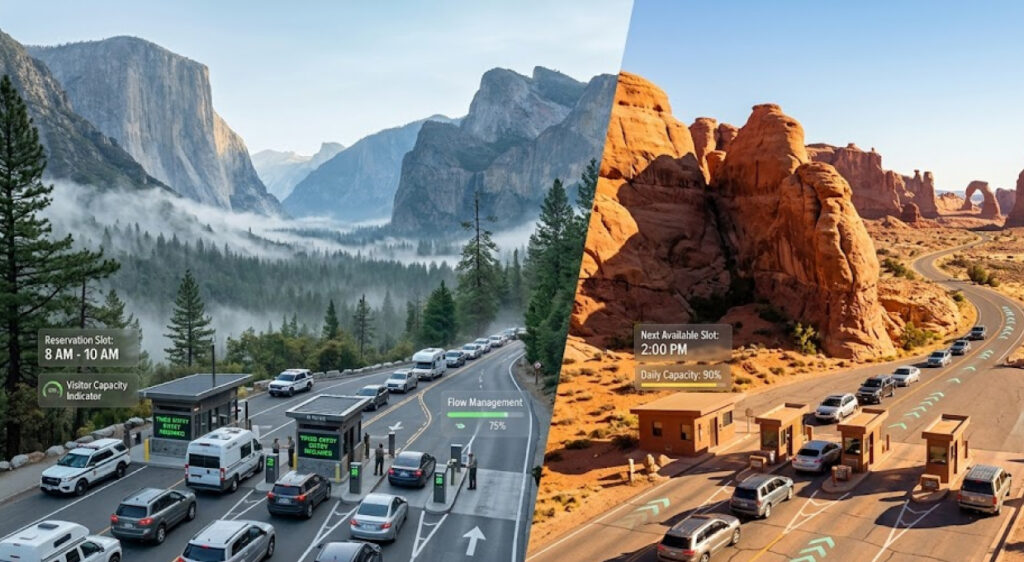
The National Park Service (NPS) has continued strengthening its visitor management framework during the Summer 2026 season through expanded reservation and timed-entry systems at two of its most heavily visited destinations: Yosemite National Park in California and Arches National Park in Utah. These operational adjustments reflect sustained pressure from rising visitation levels, infrastructure strain, and the need to balance public access with long-term resource protection.
Yosemite National Park, spanning California’s Sierra Nevada, recorded over 3.5 million annual visitors in recent pre-pandemic years, with peak congestion concentrated in Yosemite Valley, Tunnel View, and Glacier Point. Arches National Park, located near Moab, Utah, has also experienced sustained growth, surpassing 1.5 million annual visitors in recent seasons, with demand heavily concentrated around Delicate Arch and the Windows Section.
The reservation systems introduced across both parks are not temporary measures. Instead, they reflect a longer-term shift toward structured access management designed to stabilize visitor flow during peak summer months, particularly June through September.
For official operational updates and visitation frameworks, the National Park Service provides real-time park entry and planning tools through its official platform at NPS Visitor Use Planning.
Yosemite National Park Expands Timed Entry to Reduce Valley Congestion
Yosemite National Park continues to serve as a central case study in large-scale visitor flow management. The Summer 2026 expansion builds on earlier reservation systems introduced in response to severe congestion and environmental pressure within Yosemite Valley.
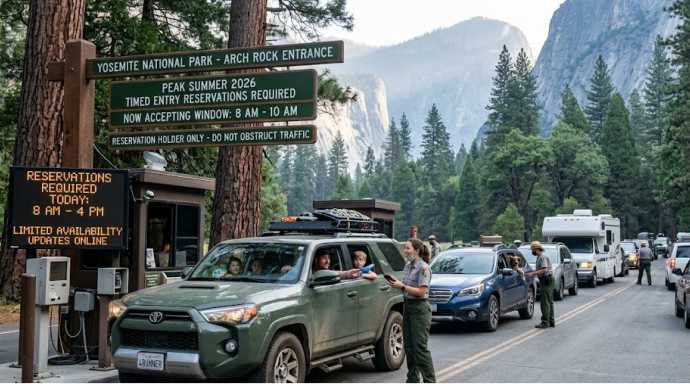
The updated system prioritizes timed entry windows for private vehicles entering the park during peak hours, particularly through the Arch Rock Entrance Station and Big Oak Flat Entrance. Park officials have placed increased emphasis on distributing visitation across less congested areas such as Hetch Hetchy Reservoir and the Tuolumne Meadows region, where environmental impact is comparatively lower.
Traffic modeling used by park planners incorporates historical congestion data, seasonal visitation spikes, and road capacity limitations along key corridors such as CA-120 and CA-140. These models inform daily adjustments to entry thresholds and visitor messaging strategies.
Communication remains a critical component of Yosemite’s system. Real-time alerts regarding availability, weather conditions, and parking status are distributed through official channels, reducing uncertainty for visitors traveling long distances.
The operational approach aligns with broader federal transportation and recreation planning frameworks supported by the U.S. DOT Transportation Systems Management, which emphasizes demand management in high-traffic public infrastructure systems.
Arches National Park Implements Structured Entry Scheduling to Protect Fragile Landscapes
Arches National Park in southeastern Utah has adopted a more structured reservation-based entry model due to its limited roadway capacity and highly concentrated visitation zones. The park’s primary corridor, Arches Scenic Drive, experiences peak congestion during early morning and late afternoon hours, particularly near iconic formations such as Delicate Arch, Landscape Arch, and the Windows Section.
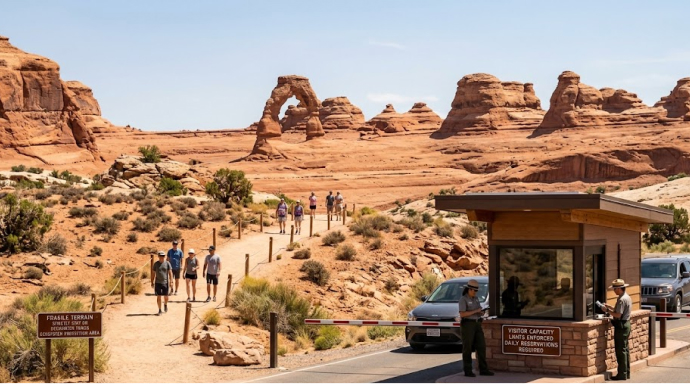
The 2026 system introduces expanded entry windows that regulate arrivals during high-demand periods. This approach reduces vehicle bottlenecks at the entrance station and allows for more controlled distribution of visitors across trailheads.
Unlike larger parks with multiple entry corridors, Arches operates within a single-access framework, making timed entry systems particularly effective in managing throughput. Park officials continue to refine visitor communication strategies to encourage advance trip planning and reduce peak-hour congestion.
Environmental preservation remains a central driver of these policies. The sandstone formations within Arches are highly sensitive to erosion and foot traffic pressure, requiring consistent monitoring and adaptive management strategies.
For additional context on public land conservation and visitor impact management, the U.S. Geological Survey provides research-based insights on ecosystem stress and land use patterns at USGS Land Resource Monitoring.
Comparative Structure of Reservation Systems Across Yosemite and Arches
Although both parks operate under the National Park Service, their reservation systems differ significantly due to geography, infrastructure, and visitor distribution patterns. Yosemite relies on a multi-entrance, distributed system, while Arches operates under a centralized entry model with strict capacity controls.
| Park Location | System Type | Primary Purpose | Operational Focus Area |
|---|---|---|---|
| Yosemite National Park | Timed entry windows | Reduce valley congestion | Multiple entrance corridors |
| Arches National Park | Fixed reservation entry | Control single-road capacity | Central scenic drive access |
These structural differences highlight how reservation systems are not standardized nationwide but instead adapted to specific park conditions and environmental constraints.
Yosemite’s system prioritizes traffic distribution across multiple zones, while Arches focuses on limiting peak entry volumes to preserve fragile geological formations and maintain visitor safety along narrow access routes.
Communication Systems and Real-Time Visitor Coordination
A defining feature of the 2026 reservation expansion is the integration of real-time communication tools across both parks. Visitors increasingly rely on mobile alerts, digital dashboards, and official park updates to adjust travel plans before arrival.
At Yosemite, dynamic updates inform travelers about entry availability and road conditions along major corridors. At Arches, reservation confirmations and entry time reminders help reduce queue formation at the entrance station.
This shift reflects a broader trend in public land management where communication infrastructure is treated as a core operational system rather than a secondary support function.
Public sector communication frameworks highlighted by the Harvard Kennedy School Public Innovation emphasize that real-time information delivery improves both compliance and visitor satisfaction in high-density public environments.
Both parks now operate within a hybrid model that combines physical infrastructure management with digital visitor coordination systems, reducing uncertainty and improving flow efficiency.
Visitor Distribution Strategies and Seasonal Pressure Management
Seasonal visitation patterns continue to drive operational planning at both Yosemite and Arches. Summer months remain the highest-pressure period, with concentrated demand during weekends and holiday periods.
Park managers have increasingly adopted visitor distribution strategies designed to redirect traffic away from peak congestion zones. In Yosemite, this includes encouraging earlier arrival times and promoting alternative destinations within park boundaries. In Arches, reservation caps inherently distribute visitors more evenly throughout the day.
These strategies reduce strain on parking infrastructure, trail systems, and ranger response capabilities while maintaining access to major landmarks.
A simplified overview of visitor management techniques illustrates the operational balance between access and protection:
| Strategy Type | Application in Yosemite | Application in Arches | Primary Outcome |
|---|---|---|---|
| Timed Entry Systems | Yes | Limited | Reduced peak congestion |
| Reservation Caps | Partial | Yes | Controlled visitor volume |
| Alternative Routing | High | Low | Distributed visitor flow |
| Real-Time Alerts | High | High | Improved visitor planning |
These combined systems demonstrate a shift toward adaptive management rather than static access policies.
Long-Term Implications for National Park Access Policy
The expansion of reservation systems at Yosemite and Arches reflects a broader transformation in how the National Park Service manages high-demand destinations. Increasing visitation levels, combined with limited infrastructure capacity and environmental sensitivity, have required more structured access frameworks.
Future policy discussions are likely to focus on how reservation systems can be refined without reducing equitable access to public lands. This includes evaluating digital accessibility, seasonal flexibility, and regional travel impacts.
As visitation continues to grow across western U.S. parks, the balance between preservation and access will remain central to operational planning. Yosemite and Arches serve as two of the most visible examples of how structured reservation systems are reshaping public land use in the United States.
Readers interested in related park system developments can explore how wellness-focused recreation is being integrated into state park programming in our coverage of California State Parks wellness initiatives.