

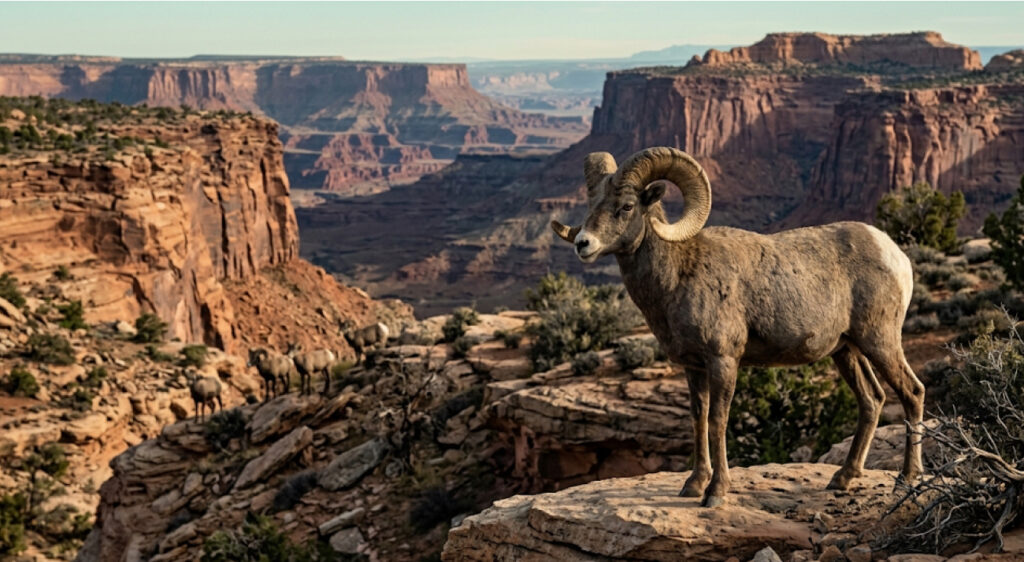
The National Park Service and three partner organizations have launched a regional wildlife research initiative to investigate the health, population trends, movements, and habitat conditions of desert bighorn sheep across southeastern Utah. Announced on November 4, 2026, the study will cover Arches, Canyonlands, and Capitol Reef national parks, along with surrounding public lands where the animals move beyond individual park boundaries.
The project brings together the National Park Service (NPS), Bureau of Land Management (BLM), Utah Division of Wildlife Resources (UDWR), and Utah State University. Its fieldwork includes helicopter surveys, wildlife capture and release operations, biological sampling, and GPS collar monitoring. Researchers expect aerial operations and capture activities to take place from early November through December.
The initiative addresses a significant information gap. According to Utah’s Watershed Restoration Initiative, comparable monitoring has not taken place in Canyonlands and Arches since 2008, while the last major effort in Capitol Reef dates to the late 1990s or early 2000s. The new research is intended to give wildlife managers more reliable information about population abundance, disease transmission, lamb survival, and habitat use.
Three National Parks Join a Regional Wildlife Research Effort
The study covers three national parks in Utah’s Colorado Plateau, a landscape characterized by deep canyons, exposed sandstone, steep cliffs, and remote desert terrain. These conditions provide important habitat for desert bighorn sheep, but they also make wildlife monitoring difficult.
Arches National Park, Canyonlands National Park, and Capitol Reef National Park contain separate management areas, yet the animals do not follow administrative boundaries. Sheep can move between park property and neighboring public lands managed by the BLM or other agencies. Research conducted within a single park could therefore miss important parts of their movements, habitat use, and exposure to disease.
The multi-agency approach is intended to address that problem by coordinating fieldwork and analysis across the wider region. The National Park Service confirmed the partnership in its November 4 announcement, describing a study focused on regional disease, population, and habitat conditions.
Lena Pace, superintendent of the Southeast Utah Group, which includes Arches and Canyonlands, said the research will provide wildlife managers with updated information needed to understand and conserve desert bighorn sheep. She identified disease, changing environmental conditions, and human recreation as pressures affecting the animals.
The project also involves Utah State University researchers Dr. Kezia Manlove and Dr. Tayler LaSharr, who are leading the study’s design, data analysis, and reporting. Their work will connect field observations with disease testing and GPS-based movement models.
The official project record is available through Utah’s Watershed Restoration Initiative, which identifies the effort as a fiscal year 2026–2027 research project.
Researchers Plan to Capture and Monitor 75 Bighorn Sheep
One of the central components is a capture and monitoring operation involving up to 75 desert bighorn sheep across the three parks. The project’s documented capture targets are:
- Canyonlands National Park: 30 sheep.
- Arches National Park: 15 sheep.
- Capitol Reef National Park: 30 sheep.
Wildlife crews will use helicopters to locate and capture animals in rugged terrain. According to the project methods, teams will use net-gunning from helicopters, bring captured sheep to a staging area for examination, and release them after processing. A wildlife veterinarian is expected to be present during capture operations.
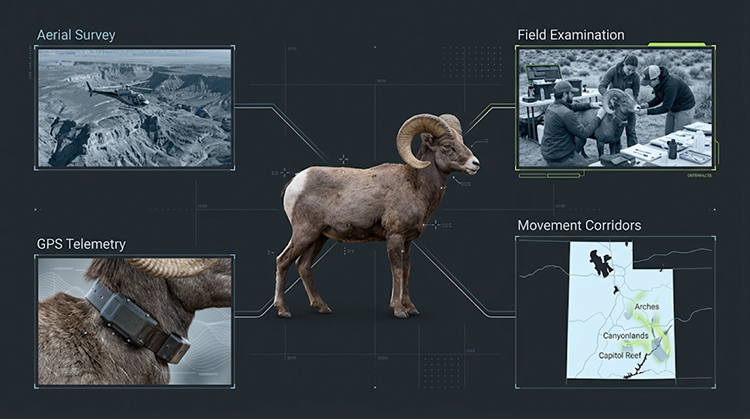
The examinations will gather information that cannot be obtained reliably from distant visual observations. Researchers plan to record age, sex, weight, and physical condition, monitor vital signs, and use ultrasound to assess body condition. They will also collect blood, fecal, and swab samples for laboratory testing.
Each selected animal will receive a GPS collar. These devices will help researchers follow movement patterns, identify frequently used habitat, and understand how different sheep populations connect across the region.
The project budget also lists 75 GPS/VHF collars, with an in-kind equipment contribution valued at $72,000. GPS tracking is particularly useful in this landscape because sheep occupy remote terrain where conventional ground surveys can produce incomplete results.
The work is expected to extend beyond the initial November and December field operations. Utah’s project documentation includes additional monitoring during 2027, with ground surveys planned to estimate population composition and lamb survival. Researchers intend to check collared female sheep around July 1, August 1, and September 1 during each study year. The September survey is particularly important for assessing summer lamb survival.
Disease Monitoring Could Explain Changes in Sheep Populations
Disease is one of the major subjects of the research. Desert bighorn sheep can be vulnerable to respiratory infections, and outbreaks can have lasting effects on herd health and reproduction.
A central focus will be Mycoplasma ovipneumoniae, commonly called M. ovi. This bacterium has been associated with respiratory disease in bighorn sheep and can contribute to pneumonia-related problems, particularly among young animals. Researchers will examine its prevalence, identify different strains, and assess disease severity across the study populations.
The investigation will also include testing for other relevant pathogens. Comparing samples from different areas may help researchers determine whether populations share disease strains and identify potential connections between herds.
This information matters because a disease problem in one location can have consequences beyond that individual habitat. If sheep move between neighboring areas, their movements may influence how pathogens circulate across a larger region. GPS tracking combined with laboratory results can help scientists investigate those relationships.
The research will also examine lamb-to-ewe ratios, a population measure that compares the number of young sheep with adult females. This provides a useful indicator of reproductive success and population dynamics. When considered alongside survival estimates and disease results, the ratio can help managers identify whether a herd is maintaining its numbers or experiencing reproductive difficulties.
The National Park Service’s bighorn sheep information for Canyonlands explains why disease has been such an important conservation concern in the region. Historical exposure to pathogens associated with domestic livestock contributed to severe declines among wild sheep populations across the Southwest.
Utah’s Bighorn Sheep Have a Long History of Recovery
The new study builds on decades of conservation work. Desert bighorn sheep once occupied large portions of the American Southwest, but their numbers declined substantially during the nineteenth and twentieth centuries. Hunting, habitat changes, competition with domestic livestock, and disease contributed to the losses.
Canyonlands National Park has played an important role in recovery efforts. When the park was established in 1964, the National Park Service estimates that approximately 100 bighorn sheep remained within its boundaries. In the 1970s, the park phased out grazing allotments inside park boundaries, while the BLM limited grazing leases on neighboring lands to cattle.
Those management changes helped reduce exposure to diseases associated with domestic sheep. During the early 1980s, wildlife biologists also began relocating animals from Canyonlands to establish herds in other parts of their historic range.
The program helped reestablish populations in Arches and Capitol Reef national parks, as well as Glen Canyon National Recreation Area. Sheep relocated to the San Rafael Swell west of Canyonlands eventually established two herds totaling more than 600 animals, according to the NPS.
The park’s historical information estimates Utah’s bighorn sheep population at approximately 3,000 animals, including roughly 350 in Canyonlands. These figures come from the park’s April 2024 information page and should be treated as historical context rather than a current count produced by the new study.
The latest research will help managers determine how populations have changed since previous monitoring efforts. It will also provide updated information about the health and distribution of animals in areas where reliable data have been limited for years.
GPS Data Could Help Protect Lambing Grounds and Critical Habitat
The study’s value extends beyond counting animals. Researchers will use GPS collar information to develop spatial models showing where sheep travel, which habitats they use, and how different populations connect.
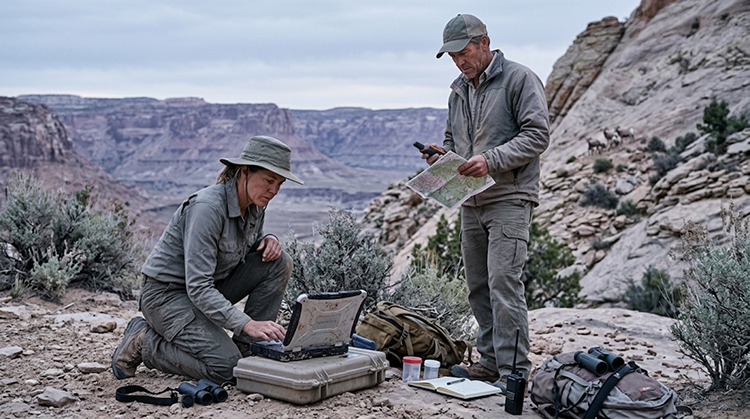
These models could help identify important feeding areas, movement corridors, and sensitive locations used during lambing season. Such information can guide decisions about recreation, infrastructure, and other activities that may affect wildlife.
The National Park Service has identified several possible management applications for the research. They include seasonal area closures to protect sensitive habitat, impact assessments for proposed projects, and improved evaluation of population changes and disease risks.
Lambing grounds are especially important because young sheep face challenges during their earliest months. Identifying areas used by females and their offspring could help park managers determine whether temporary restrictions are warranted during sensitive periods.
Recreation is another consideration. Hiking, climbing, off-road travel, and other outdoor activities can bring people into areas used by bighorn sheep. The goal is not to eliminate public access but to give managers better information about where and when human activity may create additional pressure.
The BLM and National Park Service operate across neighboring landscapes, making coordinated decisions particularly important. A seasonal restriction in one area may have limited value if animals are exposed to similar disturbances immediately beyond that boundary. Regional monitoring can help agencies consider those connections when evaluating conservation measures.
A Nearly $400,000 Investment in Long-Term Wildlife Monitoring
Utah’s Watershed Restoration Initiative lists the project’s total value at $399,481, combining direct funding and in-kind contributions. The documented funding total is $235,710, while in-kind support accounts for another $163,771.
The project record identifies several major expenses, including $75,400 for helicopter survey services, $33,700 for laboratory analyses, and $121,010 for the agreement supporting Utah State University’s research leadership, field support, data management, and reporting. The 75 GPS/VHF collars represent an additional $72,000 in equipment contributions.
The budget also includes personnel costs for park management, biological fieldwork, and follow-up ground surveys during 2027. The financial plan reflects the fact that the research requires more than a short period of helicopter activity. Captures and biological sampling are only the first steps in a process that will depend on continued monitoring and scientific analysis.
The study is listed under fiscal years 2026–2027, with some project management and field activities expected to continue for two to three years. Its findings will help establish a stronger baseline for future wildlife management decisions.
What Park Visitors Should Know During the Fieldwork
Visitors to Arches, Canyonlands, and Capitol Reef may see or hear helicopters operating near bighorn sheep habitat from early November through December. The National Park Service has advised visitors to maintain a safe distance from wildlife, aircraft, and field crews.
People should also follow directions from park employees and respect any temporary restrictions connected to research operations. The November 4 announcement does not identify a blanket closure of park roads or trails. Visitors should check the individual park websites for current information about specific activities and possible temporary closures before traveling.
The research offers a reminder that wildlife conservation often takes place beyond the visible visitor experience. While people explore Utah’s sandstone formations and desert trails, scientists and land managers are working to understand the ecological systems that support the region’s wildlife.
For desert bighorn sheep, the next stage of conservation will depend on reliable information about where animals live, how they move, and what affects their health. By bringing together three national parks, state wildlife specialists, federal land managers, and university researchers, Utah’s new study aims to provide that information across the broader landscape these animals call home.
The results could shape how agencies protect lambing grounds, assess disease risks, evaluate development proposals, and manage recreation in southeastern Utah for years to come.