

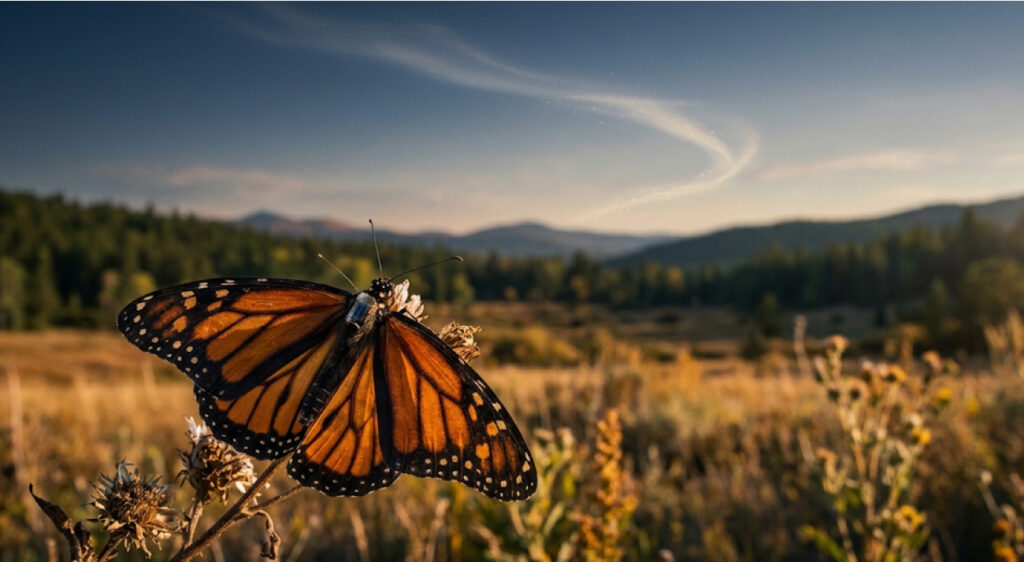
Scientists across the United States are using miniature solar-powered tracking devices to uncover previously undocumented details of the monarch butterfly’s annual migration. The research involves nearly 1,750 tagged butterflies in 2026, creating a growing collection of movement records that could help researchers identify migration corridors, feeding locations, and critical resting habitats across North America.
The project is particularly important because monarch butterflies can travel thousands of miles between their breeding grounds in the United States and Canada and their wintering locations in Mexico and California. Although scientists have studied this migration for decades, tracking individual butterflies throughout their journeys has remained difficult.
New transmitter technology is beginning to change that. The devices allow participating researchers and community scientists to collect detections as tagged butterflies pass within range of compatible smartphones and other receivers. Approximately 175 tagged monarchs had been detected in Mexico during the 2026 fall migration when the latest figures were reported in early November.
The findings are already revealing connections between regions that scientists previously understood only partially. Researchers have documented monarchs traveling from Utah toward Mexico and others moving south through the Eastern Seaboard and Florida before crossing the Gulf of Mexico.
The effort brings together conservation organizations, universities, government agencies, technology developers, and volunteers. Their shared objective is to build a more detailed picture of monarch migration and use that information to improve conservation decisions at a time when both major North American migratory populations face significant long-term pressures.
Tiny Solar-Powered Trackers Offer A New Way To Study Monarch Migration
The new tracking devices are small solar-powered radio transmitters developed by Cellular Tracking Technologies. They operate using a 2.4-gigahertz signal, the same general frequency used by Bluetooth technology.
Unlike older tracking methods, which often depended on paper identification tags and the recovery of butterflies at a later location, the new system can produce multiple detections during an individual butterfly’s journey.
The U.S. Fish and Wildlife Service explained in an October 20, 2026 update that the transmitters weigh approximately six milligrams. Their small size makes it possible to attach them to selected monarchs without using the substantially heavier equipment that previously limited insect-tracking research.
The technology was initially tested through Project Monarch in 2025, when researchers successfully captured real-time movement information from approximately 200 migrating monarchs. The 2026 effort has expanded considerably, with nearly 1,750 butterflies fitted with transmitters.
The devices are attached carefully to the butterfly’s body, generally on the thorax. Researchers must select appropriate individuals and follow specific procedures to avoid interfering with their ability to fly.
Each transmitter emits a signal that can be detected when a compatible smartphone or receiver comes within range. Those detections are then added to the project’s growing movement database.
The system does not function like a conventional GPS tracker. It does not provide a continuous, precise location for every butterfly, and researchers cannot assume that a missing signal means an individual has died. Instead, each detection provides another documented point along a migration route.
That distinction is important because scientists are trying to reconstruct movement patterns from individual observations collected across large geographic areas.
More information about the technology and the federal research effort is available through the U.S. Fish and Wildlife Service’s monarch migration update.
Nearly 1,750 Butterflies Are Being Followed During The 2026 Migration
The expansion of Project Monarch has allowed scientists to collect considerably more movement information than was available during its initial season.
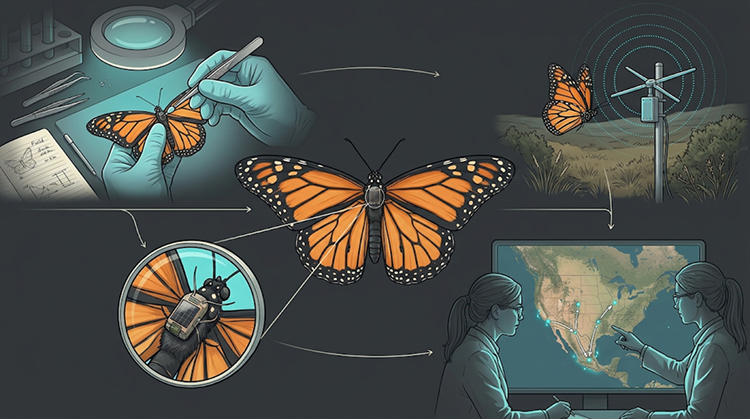
According to Associated Press reporting published November 2, researchers had fitted nearly 1,750 monarch butterflies with tracking devices during the 2026 effort. Approximately 175 tagged individuals had been detected in Mexico as the fall migration continued.
The growing dataset is helping researchers investigate where butterflies travel, which geographic corridors they use, and where they may pause during their journeys.
One of the most important participants in the research is the National Wildlife Federation, whose senior scientist Rebeca Quiñonez-Piñón is studying monarch movement and the locations where butterflies stop in Texas.
Texas is especially important because many eastern monarchs pass through the state during their seasonal movements. The region forms part of a migration corridor often called the Texas funnel.
Butterflies moving through this area need access to nectar-producing plants, water, and suitable locations where they can rest overnight. The precise routes can change from one year to another depending on environmental conditions and resource availability.
The tracking project also includes participation from organizations working across different parts of the country. The National Wildlife Federation has joined a broader collaborative effort involving scientists and conservation groups seeking to standardize tracking methods and share information.
The growing number of tagged butterflies provides more opportunities to compare individual journeys instead of relying exclusively on observations collected at widely separated locations.
However, the 175 detections in Mexico should not be interpreted as a complete count of successful migrations. They represent reported detections of tagged individuals, not the total number of monarchs reaching their wintering grounds.
Researchers Discover New Connections Between Utah, Florida, Texas, And Mexico
Some of the most interesting findings involve butterflies traveling along routes that researchers had previously struggled to document.
The U.S. Fish and Wildlife Service reported that one tagged monarch identified as UB26-UT-06-Chew originated in northeastern Utah. Researchers tagged the butterfly on September 2, 2026, and recorded its detection on October 11 in Santa Catarina, Nuevo León, Mexico.
This record was particularly significant because it provided evidence of a monarch originating west of the Rocky Mountains reaching Mexico and joining the broader eastern migration pattern.
Another tracked butterfly, identified as Mona-MJVFWS-MN26-028, began its migration in northwestern Minnesota. Its recorded journey took it toward the Missouri River in central South Dakota before it continued south through the Great Plains. Its last reported detection was in the Big Bend region of southwestern Texas.
These records demonstrate how individual butterflies can travel across several states before reaching the southern United States.
Researchers have also documented monarchs moving along the Eastern Seaboard toward Florida before crossing the Gulf of Mexico and continuing through Mexico. These observations are providing evidence of connections that scientists had previously hypothesized but could not establish at the same scale.
Emma Pelton, senior conservation biologist with the Xerces Society for Invertebrate Conservation, highlighted the importance of these individual migration stories. The findings are helping researchers identify movement patterns that were previously difficult to verify.
The discoveries are still developing, and scientists need additional seasons of tracking to determine how consistently these routes are used.
Nevertheless, the records provide a more detailed foundation for studying migration than traditional methods that typically documented a butterfly at its tagging location and, if recovered, at another point later in its journey.
Why Texas Is Important To Monarch Butterfly Conservation
Texas occupies a strategically important position in the eastern monarch migration system.
During the fall, monarchs moving south from the northern United States and Canada often pass through the state before continuing toward Mexico. The same general region becomes important again during spring migration, when butterflies move north to reproduce.
The exact route can shift depending on weather, temperature, water availability, and the distribution of flowering plants.
Rebeca Quiñonez-Piñón and other researchers are particularly interested in identifying the places where monarchs stop during these movements. Such locations can provide essential resources during a journey that may extend approximately 3,000 miles.
Adult monarchs need nectar-producing flowers to replenish energy. Their breeding cycle also depends on milkweed, because female monarchs lay their eggs on milkweed plants and their caterpillars feed on those leaves.
The availability of these resources can determine whether suitable habitat exists along important migration corridors.
Tracking information could help researchers identify locations that deserve additional conservation attention. If multiple tagged butterflies repeatedly appear in a particular region, that area may warrant further investigation as a feeding or resting location.
The information could also help conservation groups coordinate habitat restoration across state boundaries rather than concentrating efforts in isolated gardens or protected areas.
The National Wildlife Federation’s monarch conservation program provides additional information about the importance of milkweed, nectar plants, and habitat restoration.
Monarch Populations Continue To Face Significant Conservation Pressures
The tracking project is expanding at a time when monarch populations remain vulnerable to several environmental pressures.
The eastern migratory population, which travels toward wintering forests in central Mexico, has declined substantially over recent decades. The western population, which primarily winters along the California coast, has experienced an even sharper long-term decline.
Associated Press reporting in November 2026 cited declines exceeding 80% for eastern monarchs and approximately 95% for western monarchs compared with historical population levels.
These figures illustrate why identifying migration routes and important habitat locations has become a priority for conservation researchers.
Habitat loss is one of the central challenges. Agricultural expansion, urban development, changes in land management, and the removal of native vegetation have reduced the availability of suitable breeding and feeding environments.
Pesticide and herbicide exposure also presents risks. Herbicides can eliminate milkweed growing near agricultural areas, while insecticides can directly affect butterflies and other pollinators.
Climate conditions add another layer of uncertainty. Drought, extreme temperatures, severe storms, and changing seasonal patterns can affect the availability of nectar plants and the condition of overwintering forests.
The U.S. Fish and Wildlife Service identifies habitat degradation, insecticide exposure, and climate change among the major threats affecting monarch populations.
In December 2024, the agency proposed listing the monarch butterfly as threatened under the Endangered Species Act. The proposal reflected concerns about the species’ long-term prospects and the need for additional conservation measures.
The current tracking initiative does not directly resolve these threats. Its contribution is the information it can provide about where monarchs travel and which parts of their migration environment may require greater protection.
How Tracking Data Could Improve Habitat Protection
The long-term value of Project Monarch will depend on how researchers translate individual movement records into practical conservation decisions.
Knowing that a butterfly traveled from Utah to Nuevo León is useful, but identifying the resources it encountered along the way could provide even greater ecological value.
Researchers want to understand where monarchs stop, how frequently they use particular locations, and which environmental conditions support successful movement.
This information could help conservation organizations identify important areas for milkweed planting, native flowering vegetation, and habitat restoration.
Roadside vegetation is another potential area of interest. Roads can provide flowering plants and open habitat, but vehicle collisions also pose risks to migrating butterflies. Better knowledge of movement corridors could help agencies evaluate where habitat improvements and roadside management practices may be most beneficial.
Agricultural landscapes could also benefit from more detailed migration information. Farmers, ranchers, and land managers can support monarch populations by maintaining suitable milkweed and nectar resources in appropriate areas.
The U.S. Department of Agriculture’s Natural Resources Conservation Service already supports voluntary conservation efforts on working lands to establish and maintain pollinator habitat.
By combining tracking records with habitat assessments and other scientific information, researchers may be able to prioritize areas where conservation investments could provide meaningful benefits.
The technology also creates opportunities for international cooperation. Monarch migration connects ecosystems in Canada, the United States, and Mexico, meaning that successful conservation requires coordination across national boundaries.
A butterfly detected in Mexico may have crossed several states and encountered multiple habitat types along the way. Protecting only its wintering location would leave many of the other environments supporting its migration unaddressed.
The Public Can Follow Individual Monarchs Through Project Monarch Science
One distinctive feature of the initiative is the opportunity for members of the public to follow participating butterflies.
The free Project Monarch Science app allows users to view reported detections and follow individual tagged butterflies as new information becomes available.
The system makes migration research more accessible to people who might otherwise encounter the findings only through scientific publications or conservation reports.
Community participation is also important to the project’s growth. Researchers and partner organizations are involved in capturing, tagging, releasing, and monitoring monarchs across different regions.
However, public users should understand that the app displays recorded detections rather than continuous live GPS positions. A butterfly may travel a considerable distance between two recorded signals, and the absence of a new detection does not establish what happened to that individual.
The tracking system is still developing, and researchers continue to evaluate the technology, collection methods, and possible effects of attaching devices to butterflies.
Even with those limitations, the project represents a substantial improvement in the ability to observe individual migration journeys.
It also creates an opportunity to connect public interest in monarch butterflies with broader discussions about pollinator conservation, native plants, and the importance of connected habitats.
A New Research Tool For Understanding One Of North America’s Great Migrations
The 2026 monarch tracking initiative is giving scientists an increasingly detailed view of a migration that has remained difficult to follow for generations.
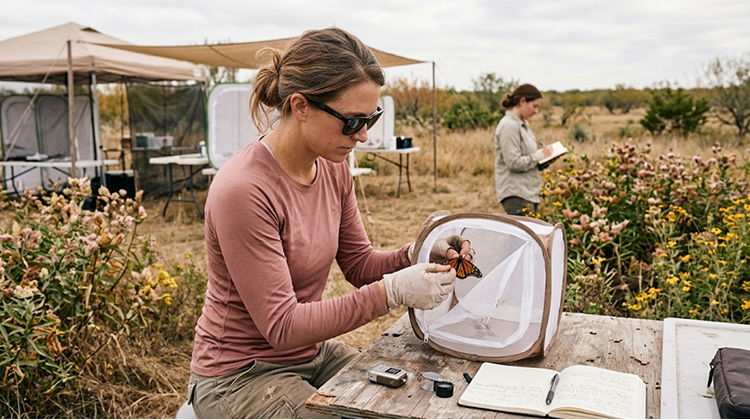
Nearly 1,750 tagged butterflies, approximately 175 reported detections in Mexico, and individual movement records connecting locations such as Minnesota, Utah, Texas, Florida, and Nuevo León are expanding the available scientific evidence.
The most important contribution may ultimately be the identification of places where monarchs depend on temporary feeding and resting opportunities during their journeys.
Those locations can be easy to overlook because they may not be famous wildlife destinations or formally protected areas. Yet their availability can influence whether butterflies find the resources necessary to continue migrating.
The project is still in its early stages, and additional tracking seasons will be needed before scientists can establish broader patterns and evaluate how consistently individual routes are used.
For conservation organizations, however, the expanding dataset offers a valuable starting point for connecting migration research with habitat restoration and land-management decisions.
The monarch’s journey crosses state lines, international borders, agricultural regions, cities, grasslands, and protected landscapes. Understanding that movement requires cooperation between researchers, public agencies, landowners, and communities.
As more butterflies receive miniature transmitters, scientists are gaining an opportunity to study those connections in greater detail.
The orange-and-black migration that once appeared as a series of scattered sightings is gradually becoming a more documented network of individual journeys. If researchers can turn that information into effective habitat protection, the tiny devices attached to these butterflies could make a meaningful contribution to the future of one of North America’s most recognizable pollinators.
For more coverage of wildlife research, conservation initiatives, public lands, and environmental developments, readers can explore national park and conservation news.